
The Unseen Link: How Your Nozzle's Condition Directly Affects Surface Profile and Coating Adhesion

The Unseen Link: How Your Nozzle's Condition Directly Affects Surface Profile and Coating Adhesion
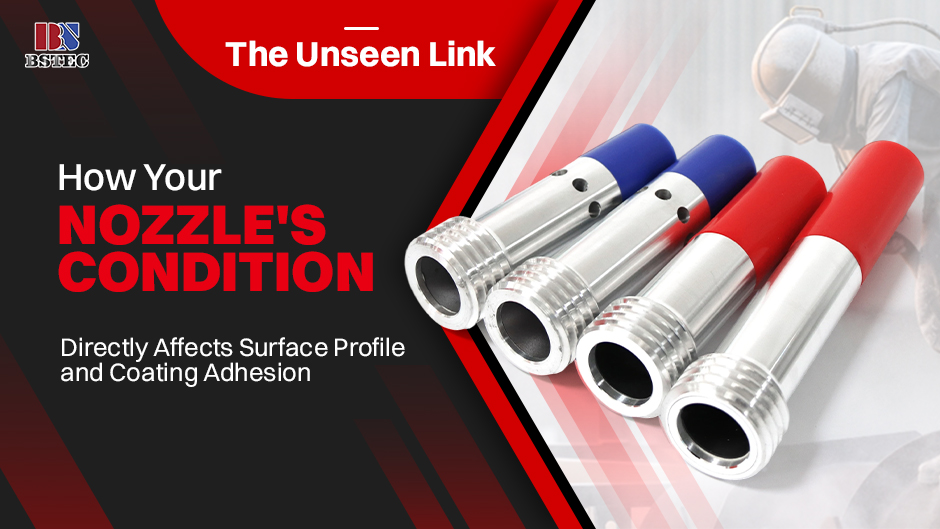 In the world of surface preparation, the final quality of a coating is only as good as the profile it's applied to. While blasting operators focus on visual cleanliness, a more critical, often unseen, factor determines long-term success: the anchor profile. And the master architect of this profile is a component rarely given a second thought—the sandblasting nozzle. Its condition forms the crucial, unseen link between your blasting operation and the ultimate durability of your coating system.
From Orifice to Anchor: The Physics of Profile Creation
A new, properly sized nozzle is engineered to produce a coherent, homogeneous stream of abrasive. Each particle travels at a consistent velocity and angle, striking the surface uniformly. This creates a clean, well-defined anchor profile with consistent peak-to-valley height—the perfect mechanical key for coating adhesion.
However, as the nozzle orifice wears, this precision disintegrates. The worn, often oval-shaped bore disrupts the laminar flow of air and abrasive. The result is an erratic, turbulent stream where particles travel at varying speeds and angles.
The Two Failure Modes of a Worn Nozzle
1.The Invisible Contaminant: Under-Cleaning and Valleys
A diffuse blast pattern lacks the focused energy to fully clean the troughs of the profile. Microscopic contaminants, soluble salts, and old coating residues remain trapped in these valleys. To the naked eye, the surface may appear white metal, but this invisible contamination creates a weak boundary layer. When a coating is applied, it adheres only to the peaks, while the valleys become initiation points for blistering and underfilm corrosion, leading to premature failure.
2. The Weakened Foundation: Over-Blasting and Peaks
Simultaneously, the inconsistent stream can overexert itself in other areas, creating peaks that are too sharp and too high. These needle-like peaks are problematic for two reasons. First, they are prone to folding over during the coating process, creating hidden, uncoated points. Second, and more critically, the coating applied over these sharp peaks is often thinner than specified (the "capping" effect), creating the weakest link in the protective system. Under mechanical stress or thermal cycling, cracks can initiate at these points.
The Consequence: A Broken Bond from the Start
A surface blasted with a worn nozzle does not have a uniform, reproducible profile. It is a landscape of contaminated valleys and fragile peaks. The coating bond is compromised from the moment of application. The adhesion failure that manifests months or years later can almost always be traced back to this unseen, initial breakdown in the surface preparation process.
Protecting the Chain at Its Weakest Link
Ensuring coating integrity requires safeguarding this critical link through disciplined nozzle management:
• Regular Measurement: Use plug gauges to monitor bore wear. Replace nozzles proactively before they reach the 15-20% enlargement threshold, where pattern degradation becomes severe.
• Pattern Validation: Regularly test blast a sample plate. A tight, even pattern indicates a healthy nozzle; a star-shaped or diffuse pattern signals it's time for a change.
• Invest in Consistency: A high-quality nozzle is not a cost; it is an insurance policy for your coating system. The minor investment in a durable tungsten carbide or boron carbide nozzle pales in comparison to the cost of a single coating failure and subsequent rework.
Do not let an unseen problem compromise your most visible results. To secure the critical link in your coating process with reliable, high-performance nozzles, trust the expertise at www.cnbstec.com. Protect your profile, ensure your adhesion, and guarantee your reputation.


