
Long-Range vs. Wide-Angle: A Practical Guide to Selecting Nozzle Type for Your Specific Blasting Project

Long-Range vs. Wide-Angle: A Practical Guide to Selecting Nozzle Type for Your Specific Blasting Project
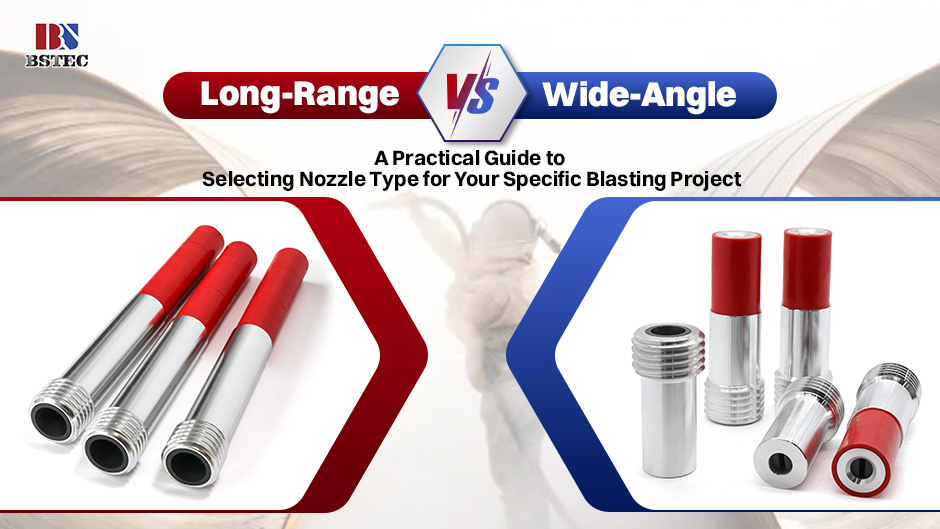
In abrasive blasting, one size does not fit all. The difference between an efficient, high-quality outcome and a costly, time-consuming struggle often comes down to one critical choice: selecting the right nozzle for the job. While material composition is important, the nozzle's geometry—specifically its ability to produce either a concentrated long-range stream or a dispersed wide-angle pattern—is what truly determines its practical application. Understanding this distinction is fundamental to project success.
The Long-Range Nozzle: Power and Precision at a Distance
Long-range nozzles, typically straight-bore or slightly venturi-designed, are engineered to maintain a tight, coherent stream of abrasive over an extended distance. They are the specialists for targeted, long-distance work.
● Key Characteristics:
Concentrated, high-density stream pattern
Minimal pattern dispersion over distance
High impact force per square inch
● Ideal Applications:
Spot Blasting and Repair Work: Perfect for targeting specific areas of corrosion or damage without affecting the surrounding surface.
Heant Duty Descaling: The focused energy is ideal for punching through thick mill scale or tenacious coatings.
Working in Confined Spaces: The tight stream allows operators to work effectively from a single, often awkward, access point.
Long-Distance Blasting: Essential for situations where the operator must remain far from the surface, such as with large-diameter tanks or certain structural elements.
The Wide-Angle Nozzle: Efficiency and Coverage for Large Surfaces
Wide-angle nozzles are almost exclusively of the Venturi design. Their diverging outlet creates a broad, fan-shaped pattern that covers a large area with each pass. They are the champions of productivity on big, open surfaces.
● Key Characteristics:
Wide, homogeneous blast pattern
Even distribution of abrasive across the pattern
Reduced abrasive rebound and overspray
● Ideal Applications:
Large, Flat Surfaces: The go-to choice for hulls, ship decks, storage tank exteriors, and large steel plates.
Profile-Sensitive Applications: The even etching action produces a consistent anchor profile, which is critical for high-performance coating adhesion.
Productivity-Critical Jobs: By covering more square feet per minute, they drastically reduce blasting time and labor costs on suitable projects.
The Selection Matrix: Making the Right Choice
Project Characteristic | Recommended Nozzle Type | Reasoning |
Long working distance | Long-Range | Maintains stream cohesion and cleaning power where a wide-angle would fail. |
Large, flat, accessible surface | Wide-Angle (Venturi) | Maximizes coverage area and productivity; provides a uniform profile. |
Precise, targeted cleaning | Long-Range | Delivers focused energy exactly where it's needed, minimizing collateral work. |
Complex geometry with recesses | Long-Range | Allows the operator to direct the stream into corners and detailed areas. |
Achieving a consistent SA 2.5 | Wide-Angle (Venturi) | The even, curtain-like pattern is inherently designed to produce a uniform profile. |
The Bottom Line: Match the Tool to the Task
Using a wide-angle nozzle on a detailed, confined project will be frustrating and slow. Conversely, using a long-range nozzle to clean a vast, flat plate is like painting a wall with a fine-tip brush—inefficient and costly.
By strategically selecting between long-range and wide-angle nozzles, you equip your team to work smarter, not just harder. For a comprehensive selection of both nozzle types, engineered for durability and peak performance in their respective roles, explore the professional range at www.cnbstec.com. Choose wisely, and transform your blasting efficiency.


