
The Silent Profit Killer: Quantifying the Cost of an Oversized or Worn-Out Sandblasting Nozzle

The Silent Profit Killer: Quantifying the Cost of an Oversized or Worn-Out Sandblasting Nozzle
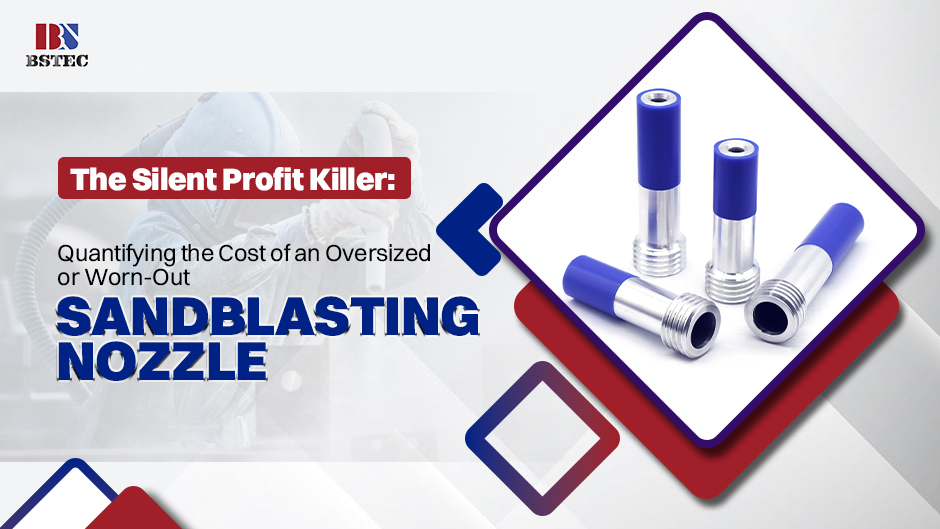
In the thunderous environment of the blasting bay, it's easy to overlook a seemingly minor issue—a slightly worn or improperly sized nozzle. While it may still be "working," this unassuming component can quietly drain your profitability with the precision of a skilled accountant. The true cost isn't just its replacement price; it's the cascading effect on your entire operation that turns a small wear item into a silent profit killer.
Let's move from vague concerns to hard numbers and quantify how this killer operates.
The Direct Costs: What You Can Measure
1.Abrasive Waste: The Obvious Leak
A new, properly sized nozzle creates a tight, focused stream that delivers abrasive efficiently to the surface. A worn or oversized nozzle produces a diffuse, erratic pattern. Industry studies and operational data confirm that a nozzle with a bore that has enlarged by just 25% can increase abrasive consumption by 30% or more. On a project using $10,000 worth of abrasive, that's $3,000 literally turning to dust in the wind.
2.Energy Drain: The Hidden Siphon
Your compressor is your largest energy consumer. A worn, oversized orifice demands a significantly higher volume of air (CFM) to maintain pressure. This forces the compressor to work harder, leading to a measurable spike in electricity consumption. This inefficient energy use can easily increase your power costs for blasting by 15-20%, a direct hit to your overhead that provides zero productive benefit.
The Indirect Costs: What Truly Erodes Your Bottom Line
3.Labor Inefficiency: Paying for Wasted Time
A weak blast pattern means the operator must make more passes to achieve the required cleanliness and profile (e.g., SA 2.5). A job that should take 8 hours stretches to 10. This 25% increase in man-hours doesn't just raise labor costs; it creates a backlog, delays project timelines, and reduces your capacity to take on new work. You are paying your most valuable asset—skilled labor—to work slower.
4.The Cost of Rework and Failed Quality
This is the most dangerous cost. An inconsistent blast pattern from a worn nozzle creates an uneven surface profile. Some areas are under-cleaned, leading to coating adhesion failure, while others are over-profiled. The consequence isn't just a simple repair—it's a full-blown, costly rework: stripping the failed coating, re-blasting, and reapplying the system. This destroys project profitability and damages your company's reputation for quality.
The Bottom Line Calculation
Let's quantify the silent killer in a single project:
• Abrasive Cost: $10,000 + 30% waste = $3,000 lost
• Energy Cost: $1,000 + 15% inefficiency = $150 lost
• Labor Cost: 80 hours @ $50/hr + 20 extra hours = $1,000 lost
Total Preventable Loss: $4,150
This figure doesn't even include the potential thousands in rework. A $100 nozzle, neglected, just cost you over forty times its value.
The defense is simple: proactive maintenance. Regularly measure the nozzle bore with plug gauges and replace them before they become a liability. Investing in high-quality, correctly sized nozzles isn't an expense—it's one of the highest-return investments you can make in your operation.
Stop funding the silent profit killer. For nozzles engineered for longevity and performance that protect your bottom line, visit www.cnbstec.com. Measure, maintain, and reclaim your profits.


