
Reading the Signs: How to Use Nozzle Wear Patterns to Predict System Failures and Schedule Maintenance

Reading the Signs: How to Use Nozzle Wear Patterns to Predict System Failures and Schedule Maintenance
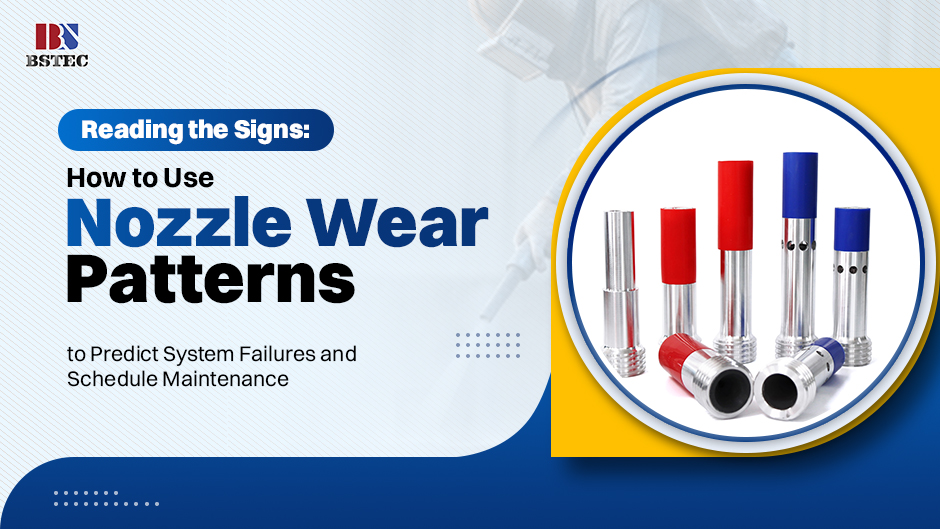
In abrasive blasting, a worn nozzle is more than a consumable item—it's a diagnostic tool. The specific way a nozzle wears provides a clear, visual log of your system's health and operating conditions. Learning to "read" these wear patterns allows you to move from reactive replacements to predictive maintenance, preventing costly downtime and component failures before they occur.
A nozzle's internal and external wear tells a story. By interpreting these signs, you can identify issues far beyond the nozzle itself.
1. Concentric (Even) Wear: The Ideal Scenario
When a nozzle wears evenly around its entire circumference, creating a slightly larger but still round orifice, this is the sign of a healthy system. It indicates proper alignment, clean and dry air, and consistent pressure. This is normal, predictable wear. The maintenance response is straightforward: track the bore size with plug gauges and plan for replacement once it exceeds 15-20% of its original diameter.
2. Asymmetric (Keyhole or Oval) Wear: The Signature of Misalignment
If the nozzle orifice becomes oval or "keyhole" shaped, the culprit is almost always misalignment. The nozzle is not sitting straight in the holder, or the holder itself is worn or damaged. This causes abrasive to consistently rub against one side of the bore.
● The Prediction: Continued operation will not only waste abrasive but also place uneven stress on your blast hose and fittings, leading to premature hose failure. The erratic blast pattern can also cause uneven surface profiles, risking coating failure.
● The Maintenance Schedule: Immediately inspect and replace the nozzle holder or clamp. Check the connection between the hose and the pot for kinks or tight bends that force the nozzle out of alignment.
3. Excessive Flare (Bell-Mouth) at the Inlet: A Symptom of Upstream Issues
When the nozzle's inlet shows significantly more wear than the rest of the bore, flaring out like a bell, it signals turbulence at the connection point. This is often caused by a worn or damaged nipple or connector just behind the nozzle. A small lip or burr on this component creates a vortex that grinds away at the nozzle's entrance.
● The Prediction: This turbulence drastically reduces efficiency and accelerates nozzle wear. Ignoring it will lead to the rapid destruction of subsequent nozzles, regardless of their quality.
● The Maintenance Schedule: Whenever you replace a nozzle showing this pattern, always replace the nipple or connector as a standard procedure. This simple step can double or triple the life of your next nozzle.
4. Rapid or Irregular Wear: The Sign of System Contamination
When a nozzle wears out far faster than its expected lifespan, or the bore appears rough and pitted, suspect moisture or dirt in the system. Water dramatically accelerates wear, while fine dust and debris act like a grinding paste.
● The Prediction: This indicates failing air dryers, filters, or moisture separators. The same contaminants damaging your nozzle are also causing internal wear to your blast pot valves, hoses, and compressor.
● The Maintenance Schedule: This is a critical warning. Immediately check and service your air drying and filtration systems. Drain moisture traps and inspect air filters.
Implementing a Predictive Maintenance Log
Transform these observations into a powerful planning tool. Create a simple log that tracks:
● Nozzle serial number/ID
● Date of installation and removal
● Observed wear pattern (e.g., "Even," "Oval," "Bell-Mouth")
● Root cause and action taken
By analyzing this data over time, you can predict your nozzle consumption, budget accurately, and schedule downtime for system-wide maintenance before a catastrophic failure occurs.
Stop simply replacing nozzles and start listening to them. For nozzles that provide a clear, honest readout of your system's health, choose materials and manufacturing precision you can trust. Find the reliable diagnostic tools you need at www.cnbstec.com. Read the signs, predict the future, and take control of your maintenance schedule.


