
Your Project-Specific Guide to Nozzle & Media Configuration

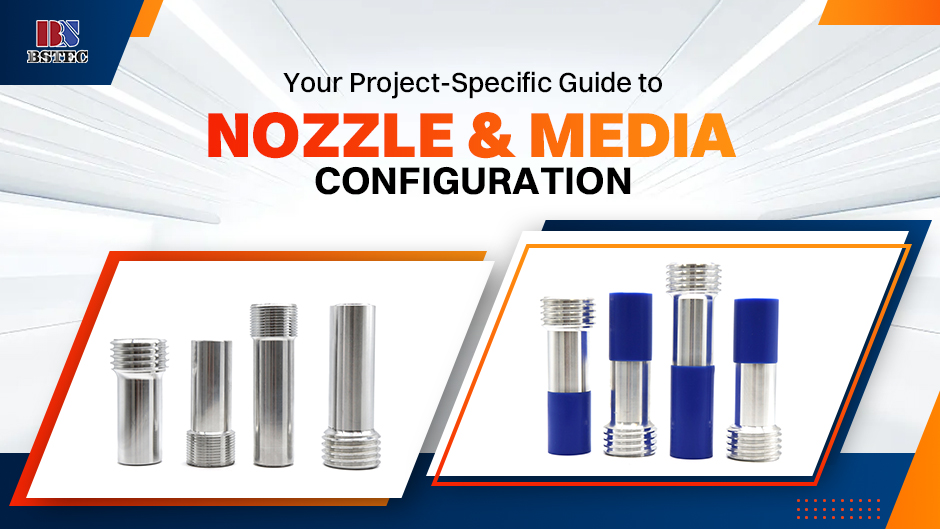
Selecting the right combination of blast nozzle and abrasive media is not merely a technical decision—it is the cornerstone of achieving optimal surface preparation results while maintaining cost-efficiency and operational safety. Whether you're tackling heavy industrial restoration or precision manufacturing applications, understanding how these two critical components interact will determine the success of your blasting project.
Understanding Blast Nozzle Fundamentals
The blast nozzle serves as the final delivery system for your abrasive media, and its configuration directly impacts pattern density, velocity, and coverage area. Nozzles are primarily categorized by their material composition and bore geometry. Tungsten carbide nozzles dominate the market due to their exceptional wear resistance, typically lasting 100-300 hours depending on media abrasiveness. For ultra-aggressive applications, boron carbide variants offer superior longevity, often outlasting tungsten carbide by 50% despite higher initial costs.
Nozzle bore diameter requires careful calculation based on your compressor's cubic feet per minute (CFM) capacity. A common industry rule suggests maintaining a 1:1 ratio between nozzle orifice size (in 1/16 inch increments) and available CFM. For instance, a #6 nozzle (3/8 inch) demands approximately 80-100 CFM at 100 PSI. Undersized nozzles create backpressure, reducing efficiency and accelerating equipment wear, while oversized nozzles fail to achieve necessary particle velocity for effective surface profiling.
Venturi-style nozzles, featuring a converging-diverging internal geometry, accelerate media particles to higher velocities than straight-bore alternatives. This design proves particularly valuable when working with lighter media or when maximum impact energy is required for removing tenacious coatings.
Abrasive Media Selection Criteria
Your media choice fundamentally dictates surface profile, substrate integrity, and project economics. The selection process must balance hardness, density, particle shape, and recyclability against specific project requirements.
Steel grit and shot excel in heavy-duty applications requiring aggressive material removal and deep anchor patterns. Angular steel grit creates sharp peaks ideal for coating adhesion, while rounded shot produces smoother finishes suitable for peening operations. These metallic media offer excellent recyclability—often sustaining 100-200 cycles—making them economically attractive for high-volume operations despite higher upfront costs.
Aluminum oxide stands as the versatile workhorse for precision work. Its 9.0 Mohs hardness tackles challenging substrates without excessive embedment concerns. Virgin brown aluminum oxide suits general industrial applications, while white variants provide contamination-free processing for aerospace and medical components. Expect 5-10 recycle passes before breakdown necessitates replacement.
Garnet offers an optimal middle ground, delivering cutting efficiency comparable to aluminum oxide with superior dust suppression characteristics. Its 7.5-8.0 Mohs hardness effectively profiles steel without over-etching, and its natural origin appeals to environmentally conscious operations. Alluvial garnet provides sharper cutting edges than rock-crushed alternatives.
For delicate substrates or sensitive environments, plastic media and sodium bicarbonate enable stripping without dimensional changes or substrate damage. These soft media (2.5-3.5 Mohs) excel in automotive restoration, aerospace maintenance, and mold cleaning where preserving base material integrity outweighs speed considerations.
Configuration Synergy and Optimization
The true art of blasting lies in harmonizing nozzle characteristics with media properties. High-density media like steel shot perform optimally with venturi nozzles that maximize kinetic energy transfer, while lightweight media such as walnut shells require straight-bore nozzles to prevent excessive velocity loss through turbulent expansion.
Air pressure settings must adapt to media hardness—brittle materials like glass beads fracture under excessive PSI, reducing cutting efficiency and generating dust. Conversely, super-hard ceramics like silicon carbide and boron carbide tolerate extreme pressures up to 120 PSI for maximum aggression.
Nozzle distance and angle further refine results. Maintain 6-12 inches from the surface for most applications, reducing distance when precision demands increase. A 45-60 degree impact angle typically optimizes cutting action while minimizing substrate deformation.
Maintenance and Safety Considerations
Regular nozzle inspection prevents catastrophic failures and maintains performance standards. Replace nozzles when bore diameter increases by 1/16 inch beyond specification—a worn nozzle requires higher pressure to maintain velocity, exponentially increasing compressor load and operational costs.
Personal protective equipment selection must match media toxicity. Crystalline silica-containing sands demand rigorous respiratory protection and have largely been superseded by safer alternatives. Always verify that your media choice complies with local environmental regulations regarding disposal and airborne emissions.
By methodically evaluating your substrate material, coating type, environmental constraints, and production targets, you can engineer a nozzle-media configuration that delivers consistent, repeatable results. Remember that the most expensive option rarely represents the best value—instead, seek the intersection where technical suitability meets economic sustainability for your specific operational context.


