
How Nozzle Wear Destroys Efficiency and How to Manage It

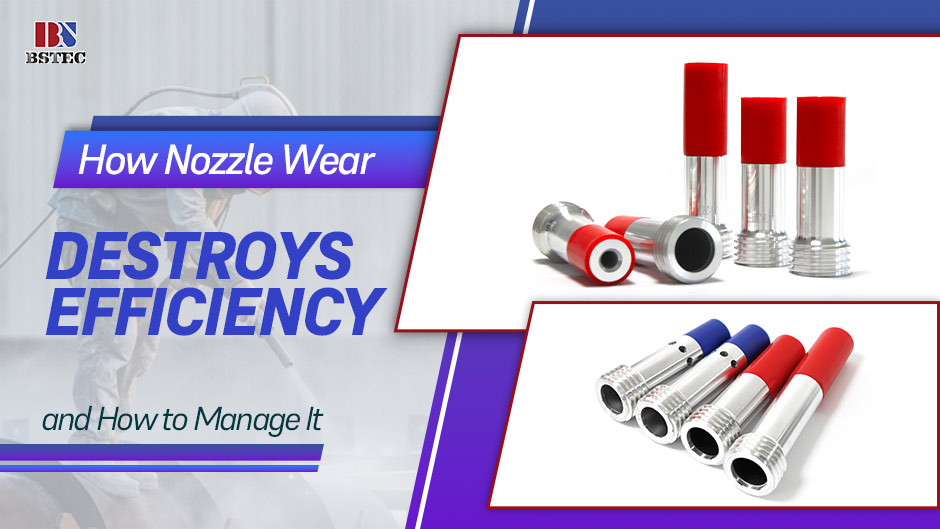
In abrasive blasting, the focus is often on the immediate output: the speed of cleaning, the quality of the profile, the completion of the job. Operators meticulously select the right nozzle size and abrasive for the task, yet frequently overlook the single component that, as it wears, silently erodes profit margins day after day. That component is the nozzle itself. A worn nozzle is not just a worn tool; it is a leak in your operational efficiency, draining money in ways that are quantifiable, preventable, and critical to manage.
The Invisible Drain: How a Worn Bore Destroys Efficiency
A new nozzle has a precise, sharp-edged bore. As abrasive particles tear through it millions of times, this bore slowly erodes, becoming larger and more irregular. This isn't a minor issue—it's a systemic failure with cascading effects:
1. Plummeting Pressure and Velocity: The enlarged, misshapen bore disrupts the laminar flow of air and abrasive. Pressure drops significantly at the exit point. Since cleaning speed is proportional to the square of the velocity, even a small pressure drop leads to a dramatic increase in blasting time. What took one hour with a new nozzle can easily take 1.5 hours with a worn one.
2. Skyrocketing Abrasive Consumption: The disrupted flow pattern causes abrasive to scatter and ricochet inefficiently. Instead of a concentrated stream impacting the work surface, a significant portion sprays wastefully into the environment or rebounds wildly. It’s common for a worn nozzle to consume 25-40% more abrasive to achieve the same result.
3. Spiraling Energy Costs: Your compressor must work harder and longer to try to maintain pressure through what is essentially a leaking orifice. This leads to extended compressor run times, significantly increasing electricity consumption—one of the highest fixed costs in a blasting operation.
4. Unpredictable, Inferior Results: An irregular bore produces an erratic stream pattern. This leads to an inconsistent surface profile, with some areas under-cleaned and others over-cut (featheredging), compromising coating adhesion and ultimately, project quality.
From Silent Killer to Managed Asset: A Proactive Maintenance Protocol
Treating nozzles as disposable items to be run until they fall apart is a costly strategy. The solution is to manage them as precision assets with a clear lifecycle. Here is a four-step protocol:
1. Establish a Baseline and Measure Religiously
When you install a new nozzle, record its baseline data: the exact bore size (use a plug gauge set), its weight (on a gram scale), and the installation date. This is your benchmark.
The Gauge Test: The most direct method. Regularly insert pin gauges into the bore. For critical work, replace the nozzle when it wears 1/32 inch (0.8mm) over its original size. For general work, 1/16 inch (1.6mm) is the absolute maximum.
The Weight Test: Simpler and equally effective. Weigh the new nozzle. Most manufacturers provide a "scrap weight." When the nozzle loses 10-15% of its original weight (or reaches the specified scrap weight), replace it. Weight loss correlates directly with bone erosion.
2. Implement a Tracking System
Don't rely on memory. Use a simple log sheet or digital tracker for each blasting station. Record:
· Nozzle ID / Type
· Installation Date & Baseline Measurements
· Hours of Operation (using an hour meter on the blasting machine is ideal)
· Inspection Dates and Measurements
· Replacement Date and Final Wear State
This data reveals the true cost-per-hour of different nozzle types and abrasives, enabling smarter purchasing decisions.
3. Adopt a Scheduled Replacement Policy
Based on your tracking data, move from a reactive "run-to-failure" model to a proactive replacement schedule. If you know a specific tungsten carbide nozzle lasts ~300 hours with steel grit before efficiency drops, plan to replace it at 250-275 hours. This ensures consistent quality and avoids the rapid efficiency fall-off in the final hours of use.
Pro Tip: For multi-gun operations, replace all nozzles on a project simultaneously. Mixing old and new nozzles creates uneven surface profiles and complicates quality control.
4. Calculate the True Cost of Ownership
Justify premium nozzles (like long-venturi boron carbide) with a total cost analysis. While its initial price may be 4x that of a basic ceramic nozzle, if it lasts 10x longer, consumes 30% less abrasive, and completes jobs 20% faster, the ROI is substantial. Factor in abrasive savings, labor hours, and energy costs—not just the price tag.
Conclusion: Profitability is in the Details
In the demanding business of surface preparation, profit margins are built on efficiency. A worn sandblasting nozzle is a silent, progressive threat to that efficiency, directly converting potential profit into wasted abrasive, excess energy, and unbillable labor hours. By implementing a disciplined management program—measuring wear, tracking performance, and replacing nozzles proactively—you transform this hidden cost center into a controlled, optimized variable. Stop letting worn nozzles silently kill your profit. Start managing them, and watch your efficiency—and your bottom line—sharpen.


