
Five Costly Sandblasting Nozzle Mistakes Every Beginner Makes (And How to Avoid Them)

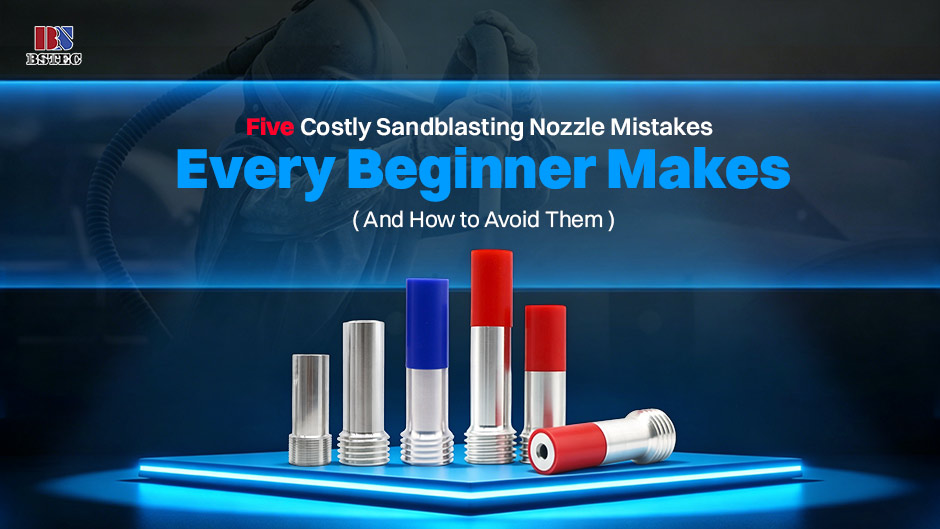
Sandblasting seems straightforward—point the nozzle and pull the trigger. Yet beneath this apparent simplicity lies a minefield of expensive errors that separate seasoned professionals from frustrated beginners. These mistakes don't just drain your wallet through premature equipment failure; they compromise safety, destroy project timelines, and deliver subpar results that demand costly rework. Here are the five most expensive nozzle-related blunders novices make, and the proven strategies to sidestep them entirely.
Mistake #1: Running the Wrong Nozzle Bore Size
The most fundamental error beginners commit is mismatching nozzle diameter to compressor capacity. A #8 nozzle (1/2 inch) bolted onto a 15 CFM hobby compressor creates catastrophic inefficiency. The compressor runs continuously, overheats within minutes, and fails to generate sufficient pressure to accelerate media effectively. Conversely, choking a 185 CFM industrial unit with a #4 nozzle wastes 60% of available airflow while creating destructive backpressure that pulverizes valves and hoses.
The Fix: Calculate your optimal bore using the 1:1 rule—match your nozzle's numbered size (in 1/16 inch increments) to your compressor's CFM output at 100 PSI. Running a 90 CFM unit? Install a #6 nozzle (6/16 inch or 3/8 inch). When in doubt, size down rather than up; an undersized nozzle merely limits speed, while an oversized one destroys equipment and wastes abrasive media through insufficient velocity.
Mistake #2: Ignoring Nozzle Wear Until Catastrophic Failure
Beginners routinely operate nozzles worn 3/16 inch beyond original specifications, hemorrhaging money through invisible inefficiencies. A worn nozzle requires 20-30% higher pressure to maintain particle velocity, forcing your compressor into constant high-load operation that accelerates mechanical wear and spikes fuel consumption by 15-25%. Worse, the enlarged bore creates a turbulent, dispersed pattern that doubles media consumption while producing uneven surface profiles requiring rework.
The Fix: Implement weekly bore measurements using a dedicated nozzle gauge. Replace tungsten carbide nozzles when wear exceeds 1/16 inch, and boron carbide units at 3/32 inch wear. Track operating hours meticulously—most beginners discover their "perfectly good" nozzle has exceeded 200 hours of runtime and expanded 20% beyond specification. The $40 replacement cost pales against the $200+ in excess compressor fuel and media waste accumulated during the final 50 hours of operation.
Mistake #3: Selecting Material Based on Price, Not Application
Novices gravitate toward cheap ceramic nozzles for heavy industrial work, watching them disintegrate within 10 hours of steel grit exposure. Others invest in premium boron carbide for occasional light-duty jobs, tying up capital that could fund six months of consumables. This misalignment stems from misunderstanding the wear dynamics—ceramic fails catastrophically under impact, while tungsten carbide degrades predictably, allowing scheduled replacement.
The Fix: Match material to media hardness and project volume. For steel grit or aluminum oxide exceeding 40 hours monthly, specify boron carbide (500+ hour lifespan). Tungsten carbide handles 100-300 hours economically for moderate use. Reserve ceramic nozzles exclusively for soft media like soda or plastic, where their $8 price point makes sense despite fragility. Calculate cost-per-hour rather than sticker price—a $120 boron carbide nozzle lasting 400 hours costs $0.30/hour, while replacing $25 ceramic units every 20 hours runs $1.25/hour.
Mistake #4: Operating at Incorrect Standoff Distance and Angle
Beginners instinctively press nozzles close to surfaces for "more power" or hold them perpendicular for direct impact. Both approaches destroy efficiency. At 3 inches distance, the blast pattern contracts to 2 inches, requiring triple the passes and embedding media into soft substrates. Ninety-degree angles maximize rebound, creating dust clouds that obscure visibility and accelerate nozzle wear through ricochet abrasion.
The Fix: Maintain 8-12 inches standoff for general blasting, extending to 18 inches for delicate substrates. Position the nozzle at 45-60 degrees to the surface—this optimizes cutting action while directing rebound away from the operator. Practice consistent sweeping motions at 2-3 inches per second. These parameters maximize pattern width (typically 1.5x nozzle bore diameter at proper distance) and minimize media embedment, reducing cleanup time by 40%.
Mistake #5: Neglecting Moisture Control and Daily Maintenance
Compressed air carries water vapor that condenses in hoses and nozzles, creating wet abrasive clumps that clog orifices and create erratic spray patterns. Beginners blame "bad media" when their nozzle sputters and spits, unaware that a $20 moisture separator would have prevented $200 in wasted garnet and three hours of downtime clearing blockages.
The Fix: Install a refrigerated air dryer or at minimum a coalescing filter with automatic drain upstream of the blast pot. Drain moisture traps every two hours during operation. At day's end, run dry air through the nozzle for 60 seconds to clear residual media that attracts atmospheric moisture overnight. Store nozzles in dry conditions—corrosion on precision-machined venturi surfaces destroys their aerodynamic efficiency permanently.
Conclusion
These five mistakes share a common thread: they result from treating the nozzle as a passive fitting rather than a precision instrument requiring specification, monitoring, and maintenance. By sizing correctly, tracking wear, selecting appropriate materials, optimizing technique, and controlling moisture, beginners immediately elevate their operational efficiency to professional standards. The savings extend beyond equipment longevity to encompass media consumption, fuel costs, labor hours, and rework elimination—transforming sandblasting from a money pit into a profitable, predictable process.


