
The Advantages of Short Venturi Blasting Nozzles

The Advantages of Short Venturi Blasting Nozzles
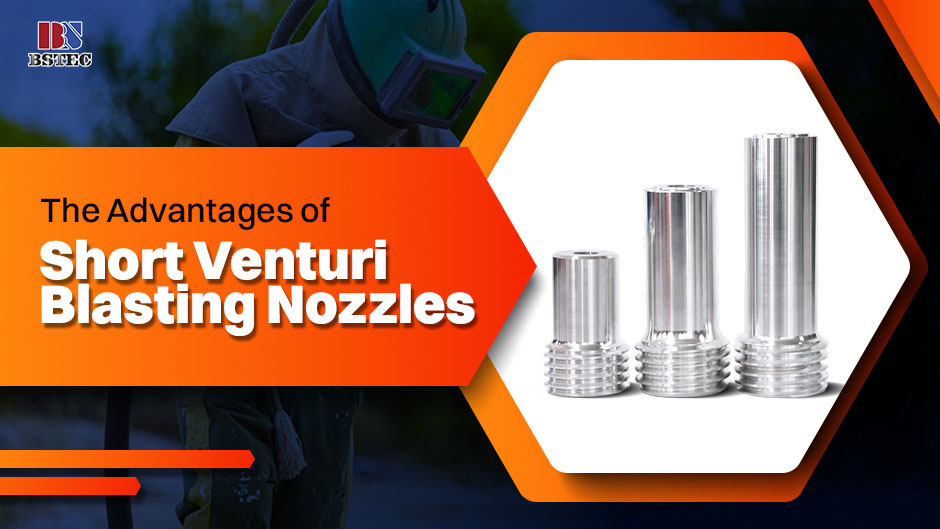
In the abrasive blasting industry, no single tool is perfect for every job. While the long venturi nozzle reigns supreme for open, production-level work, a significant portion of blasting occurs in environments where space is constrained, and tasks are varied. This is where the short venturi blasting nozzle establishes its critical value. Often described as a "semi-venturi" or "venturi-style" nozzle, it is not merely a truncated version of its longer counterpart. Instead, it is a purpose-engineered hybrid that masterfully balances core principles of efficiency with the uncompromising demands of real-world accessibility. Its advantages are profound for operations that prioritise versatility, making it the indispensable workhorse for maintenance, fabrication, and repair.
1. Tighter, more focused blast stream
The diverging section of a Venturi is shortened, so the expansion angle of the air/abrasive jet is smaller. The result is a “stingier” pattern that concentrates kinetic energy into a smaller footprint. On weld seams, edges, gasket grooves, rivet lines, or robotic paths where overspray is wasted motion, this focus translates directly into cleaner, sharper profiles and less re-work.
2. Reduced stand-off sensitivity
Because the jet stays coherent for a shorter distance, the short Venturi delivers almost the same particle velocity over a practical working window. Operators do not have to “dance” in and out to maintain the perfect stand-off the way they do with long nozzles; the penalty for drifting a few centimetres is modest. On scaffolding, inside ducts, or when blasting overhead, this forgiveness speeds up the job and reduces fatigue.
3. Compact length for confined spaces
A short nozzle plus coupler can be manipulated inside small-diameter pipe, boiler tubes, or the intrados of box girders where a long Venturi simply does not fit. Refineries and ship tanks therefore standardise on short Venturis for maintenance blasting because one nozzle can address most of the internal geometry without tool changes.
4. Lighter weight, lower moment arm
A boron-carbide short Venturi weighs considerably less than its long counterpart. On a typical blast hose, the torque felt by the operator is noticeably reduced—enough to cut shoulder strain over an eight-hour shift. For robotic arms, the lighter nozzle allows faster acceleration and tighter path radius without sacrificing wear life.
5. Faster start-up surge suppression
The internal volume of a short Venturi is lower. When the dead-man valve is opened the abrasive plug reaches the nozzle throat sooner and the pressure spike dissipates quickly. This reduces hose whip, improves operator safety, and limits the “first-surface” gouging that often occurs while the long nozzle is still filling.
6. Lower compressed-air demand for small compressors
Field contractors frequently run tow-behind compressors with limited output. A long Venturi can demand more air than the machine can supply, forcing the pressure to sag. The short Venturi, with its smaller expansion section, typically consumes less air at the same pressure, keeping the compressor inside its sweet spot and avoiding the productivity loss that occurs when pressure drops.
7. Economical wear life
Although the absolute life is shorter than that of a long nozzle, the wear rate per hour is almost identical because the throat velocity is the same. Contractors like the predictable life on aggressive steel-grit jobs: the nozzle is changed during scheduled maintenance, eliminating mid-shift failures that are common with long nozzles pushed beyond their comfort zone. The purchase price is lower, so the lifetime cost per square metre blasted remains attractive.
8. Quicker pattern change-over on multi-gun robots
Automated blast rooms often carry several guns on a transverse axis. A short Venturi’s reduced length allows guns to be spaced closer together, doubling strip density without increasing traverse speed. When a nozzle wears out, the lighter weight makes the tool-changer faster and puts less inertia on the carousel, extending robot life.
Conclusion
The short Venturi blasting nozzle is not merely a “cut-down” version of the long Venturi; it is a deliberately optimised tool that trades a small amount of theoretical exit velocity for a cluster of operational advantages—tighter pattern, lower air demand, lighter weight, confined-space access, and forgiving stand-off behaviour. In field maintenance, rental fleets, robotic cells, and any application where manoeuvrability or compressor capacity is constrained, those advantages translate into faster cycle times, lower labour cost, and more consistent surface finish.


