
Silicon Carbide (SiC) Ceramic Properties Guide: Hardness, Thermal Conductivity, and Corrosion Resistance Explained

Introduction
Silicon carbide ceramic has emerged as one of the most important advanced engineering materials of the 21st century. Its unique combination of extreme hardness, exceptional thermal conductivity, and outstanding chemical resistance makes it indispensable across industries from semiconductors to chemical processing. This guide explains the key properties that make SiC so valuable.
Hardness: Near-Diamond Wear Resistance
Silicon carbide measures 9.5 on the Mohs hardness scale, ranking just below diamond (10) and above corundum (9). In practical terms, this means SiC can resist abrasive wear from almost all materials except diamond itself. Vickers hardness testing typically shows values of 2,500–2,800 HV, far exceeding most metals and traditional ceramics.
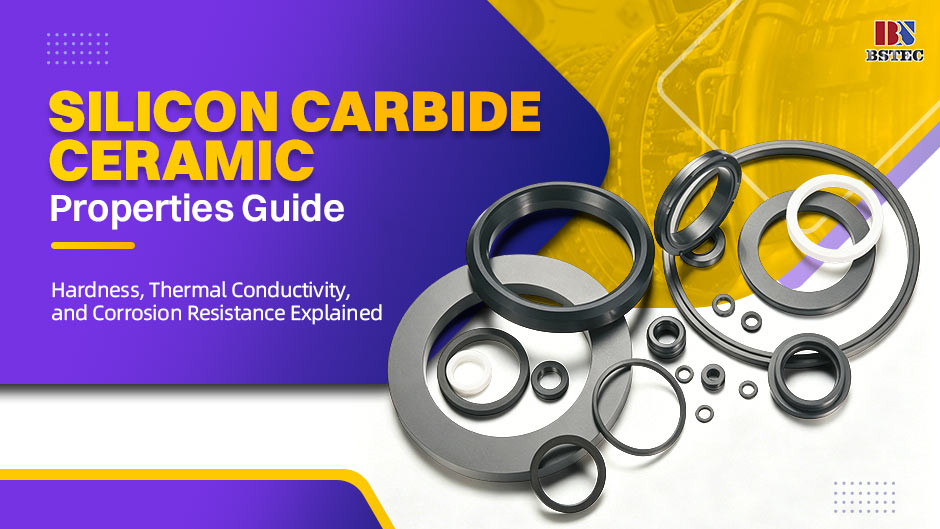
For seal rings, bushings, and wear parts, this hardness translates directly to extended service life. A silicon carbide component will maintain its dimensional accuracy far longer than steel, tungsten carbide, or aluminum oxide alternatives.
Thermal Conductivity: Superior Heat Dissipation
With thermal conductivity reaching 120–200 W/m·K, silicon carbide outperforms most other ceramics and even some metals. For comparison, stainless steel conducts at approximately 15 W/m·K, and zirconia ceramics at only 3 W/m·K.
This property is critical for applications involving heat generation. In mechanical seals, SiC rapidly conducts frictional heat away from the sealing interface, preventing hot spots, thermal cracking, and lubricating film breakdown. In electronics, SiC components efficiently spread heat from power devices.
Corrosion Resistance: Chemical Inertness
Silicon carbide exhibits exceptional resistance to nearly all corrosive media. Testing shows near-zero weight loss after 24-hour immersion in 95% sulfuric acid at 95°C, 60% nitric acid at 90°C, and 30% sodium hydroxide at 80°C.
This chemical inertness makes SiC ideal for pump seals, valve components, and reactor parts in chemical processing, pharmaceutical manufacturing, and semiconductor fabrication where contamination cannot be tolerated.
Additional Properties
Silicon carbide also offers low thermal expansion (3.7 × 10⁻⁶ K⁻¹), excellent thermal shock resistance, and maintains mechanical strength above 1,400°C. These properties enable applications ranging from furnace furniture to high-temperature structural components.
Selecting the right material for your chemical processing application requires careful analysis of your specific operating conditions. Every process is unique, and the wrong choice can lead to costly downtime, product loss, and safety hazards.
At BSTEC, we have decades of experience helping chemical processors select and manufacture the optimal silicon carbide and tungsten carbide products for their specific needs. Our engineering team can review your process parameters—temperature, pressure, chemical composition, solids content, and equipment type—and recommend the ideal material grade for your application.


