
Why Silicon Carbide Seal Rings Are the Preferred Choice for Semiconductor Manufacturing Equipment

 Introduction
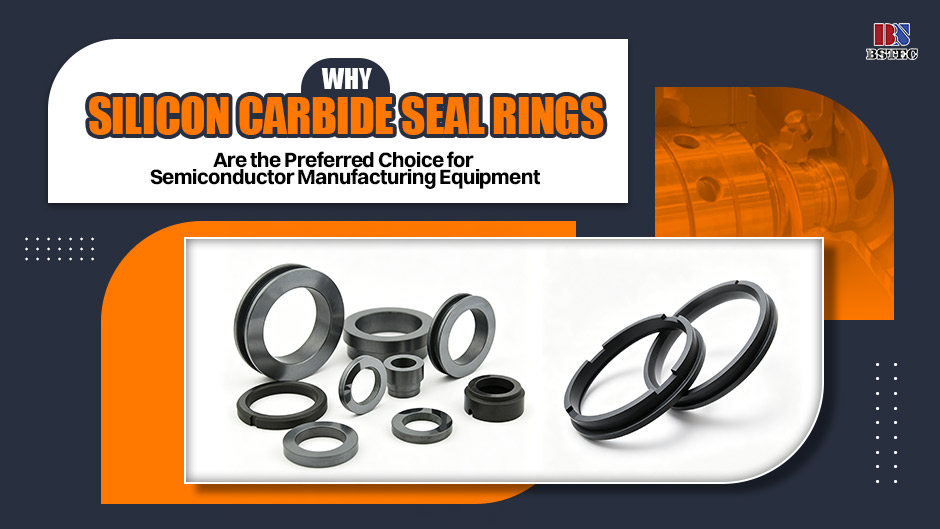
Semiconductor manufacturing imposes some of the most demanding requirements on materials. Extreme purity requirements, aggressive process gases, high temperatures, and plasma environments all challenge component durability. Silicon carbide seal rings have emerged as the preferred solution for many semiconductor applications. This article explains why.
Purity Requirements
Semiconductor fabrication requires components that do not contaminate the process environment. Any particle generation, metal ion leaching, or outgassing can destroy wafer yields. Silicon carbide offers exceptional purity, with advanced grades achieving 99.999% purity levels.
Unlike metals that can leach ions, or polymers that can outgas, high-purity silicon carbide remains stable and inert even in aggressive plasma environments. This makes it suitable for critical components such as wafer carriers, susceptors, and chamber liners.
Thermal Management
Semiconductor processes often involve rapid heating and cooling cycles. A wafer carrier must heat evenly and cool quickly to maximize throughput. Silicon carbide's high thermal conductivity (160 W/m·K) enables fast, uniform temperature changes.
Additionally, SiC's low coefficient of thermal expansion (3.7 × 10⁻⁶ K⁻¹) prevents warping or cracking during thermal cycling, maintaining critical dimensional tolerances across thousands of cycles.
Plasma Resistance
Many semiconductor processes use plasma etching and deposition. These plasmas can rapidly erode conventional materials. Silicon carbide demonstrates excellent resistance to plasma attack, particularly fluorine-based plasmas commonly used in dielectric etching.
Components made from silicon carbide maintain their surface finish and dimensional accuracy far longer than aluminum, quartz, or even some other ceramics, reducing particle generation and extending maintenance intervals.
Semiconductor Applications
Common SiC components in semiconductor equipment include wafer handling components, susceptors, diffusion furnace tubes and boats, plasma etch chamber liners, and pedestals for CVD and PVD processes. In each case, the combination of purity, thermal performance, and plasma resistance provides clear advantages.
Final Thoughts
Silicon carbide has earned its position as the preferred material for many semiconductor manufacturing components, including seal rings, for good reason. Its combination of high purity, exceptional thermal conductivity, low thermal expansion, plasma resistance, and dimensional stability directly addresses the most critical challenges facing modern semiconductor fabs.
As semiconductor devices become more complex and manufacturing tolerances continue to tighten, the demand for high-performance materials like silicon carbide will only grow. By choosing the right SiC components and the right supplier, you position your fab or equipment for higher yields, lower costs, and greater reliability.


