
Sintered vs. Hot-Pressed Boron Carbide Nozzles

Sintered vs. Hot-Pressed Boron Carbide Nozzles
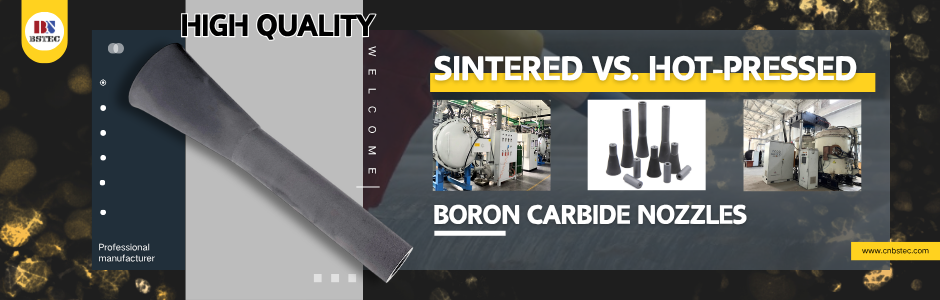
In the demanding world of abrasive blasting, where profitability is directly tied to uptime and consumable costs, the nozzle is the critical point of failure. It is the component that channels a high-velocity, abrasive-laden stream, enduring a relentless assault that quickly destroys lesser materials. For operations where longevity and performance are paramount, boron carbide (B₄C) nozzles are the industry's gold standard.
However, a crucial decision must be made: sintered boron carbide or hot-pressed boron carbide? This choice is not a minor specification but a fundamental strategic decision impacting your blasting efficiency, operational budget, and total cost of ownership.
Why Boron Carbide for Blasting?
Boron carbide is the third hardest material known, after diamond and cubic boron nitride. This exceptional hardness translates into unparalleled resistance to the abrasive wear caused by sand, corundum, garnet, and other blasting media. While other materials like tungsten carbide and silicon carbide are used, boron carbide offers a significant step-up in service life, making it the preferred choice for high-volume, professional blasting operations.
The challenge lies in boron carbide's inherent difficulty in being densified into a solid component. This is where the manufacturing processes—sintering and hot-pressing—create two distinct products with different performance and economic profiles.
The Core Difference: Manufacturing Makes the Material
Sintered Boron Carbide (Pressureless Sintering)
This process involves compacting boron carbide powder into a rough "green" nozzle shape and then firing it in a high-temperature furnace. The intense heat causes the powder particles to bond and densify. However, without applied pressure, achieving full density is challenging. The result is a nozzle with 90-98% theoretical density, meaning it contains a fine network of interconnected microscopic pores.
Hot-Pressed Boron Carbide (HP-B₄C)
This superior, more complex process involves loading boron carbide powder into a precision graphite die, which is then subjected to simultaneous high heat and intense uniaxial pressure. The combination of heat and pressure plastically deforms the particles, forcibly eliminating voids and achieving a near-perfect density of >99% of theoretical. The resulting microstructure is exceptionally fine-grained and virtually pore-free.
Performance Comparison in the Blasting Environment
The following table summarizes the key differences:
| Feature | Sintered Boron Carbide | Hot-Pressed Boron Carbide |
| Manufacturing Process | Pressureless sintering at high temperature. | Simultaneous application of high heat and uniaxial pressure. |
| Final Density | Lower (90-98% theoretical) Contains interconnected porosity. | Extremely High (>98-99.5% theoretical). Near-pore-free. |
| Microstructure | Porous, potentially with larger grains. | Fine-grained, uniform, and dense. |
| Hardness | High, but compromised by porosity. | Exceptional. Represents the full potential of B₄C hardness. |
| Wear Resistance | Very Good. Superior to tungsten carbide. | Best-in-Class. The benchmark for abrasive wear resistance. |
| Surface Finish (Internal) | Rougher due to surface porosity. | Very smooth, almost polished from the die. |
| Mechanical Strength | Lower. Porosity acts as stress concentrators. | Higher flexural strength and fracture toughness. |
| Cost | Lower. More suitable for mass production. | Significantly Higher. Batch process, expensive equipment. |
| Geometric Limitations | More flexible for complex shapes. | Limited to simple, axisymmetric shapes. |
Practical Implications for Your Blasting Operation
1. Nozzle Life and Total Cost of Ownership (TCO):
This is the most critical calculation. While a hot-pressed B₄C nozzle may cost twice as much as a sintered one, its ability to last twice as long (or more) changes the economic equation.
●Hot-Pressed B₄C: The high initial price is offset by dramatically longer service intervals. This translates directly into:
●Reduced Downtime: Fewer nozzle changes mean more productive blasting hours.
●Lower Labor Costs: Less time spent by operators on maintenance and replacement.
●Predictable Scheduling: Extended nozzle life allows for better maintenance planning and inventory control.
●Sintered B₄C: The primary advantage is the lower capital outlay per nozzle. This can be the right choice for operations where budget is the immediate constraint or where blasting is intermittent.
2. Blast Pattern and Process Control:
The internal surface finish and wear uniformity of a nozzle impact the consistency of the blast stream.
●Hot-Pressed B₄C: Its pore-free, smooth internal surface and resistance to asymmetric wear ensure the blast pattern remains consistent and focused. This is critical for achieving uniform surface profiles and for automated blasting processes where consistency is key.
●Sintered B₄C: As the nozzle wears, the porosity can contribute to a less uniform wear pattern, potentially leading to a gradual deterioration in blast stream focus and surface finish consistency over its life.
Conclusion: Making the Right Choice for Your Business
The decision between sintered and hot-pressed boron carbide is a strategic balance between immediate costs and long-term value.
Choose Hot-Pressed Boron Carbide (HP-B₄C) if:
●You operate a high-volume, high-utilization blasting facility.
●Downtime for nozzle changes is a significant cost and productivity killer.
●You require consistent blast patterns for quality control, especially in critical-path operations like shipyard blasting or large-scale structural steel preparation.
●Your focus is on minimizing the Total Cost of Ownership, and you have the capital to invest in longer-lasting components.
Choose Sintered Boron Carbide if:
●You are on a strict budget, and the initial purchase price is the most important factor.
●Your blasting operations are intermittent or low-volume.
●You are in a general fabrication or maintenance environment where the ultimate in surface profile consistency is less critical.
In summary, for the serious blasting professional, hot-pressed boron carbide represents the pinnacle of performance and operational economy. For those seeking a cost-effective entry into the superior performance of boron carbide, the sintered version offers a compelling and robust alternative. By understanding the technology behind your nozzle, you can make an informed investment that directly boosts your bottom line.


