
The Complete System: How Nozzles, Air Pressure, and Abrasive Media Work Together for Optimal Results

The Complete System: How Nozzles, Air Pressure, and Abrasive Media Work Together for Optimal Results
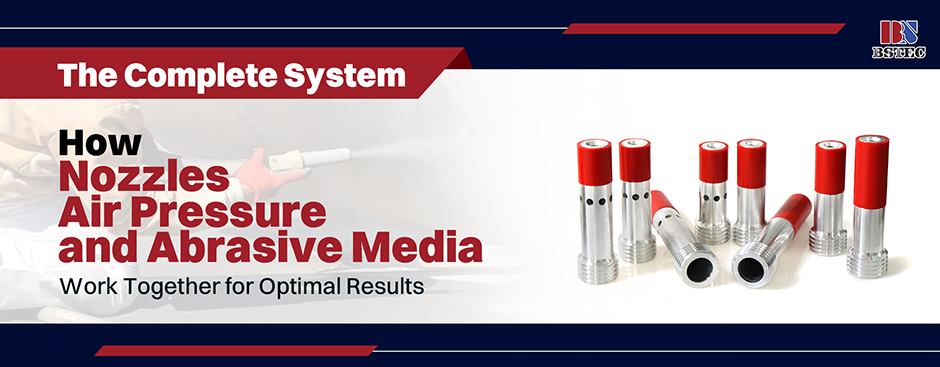
In abrasive blasting, the nozzle is often hailed as the star performer. However, it cannot function alone. It is, in fact, the critical link in a tightly integrated system that includes the air compressor, the blast hose, and the abrasive media. Ignoring this interdependence is the most common mistake in blasting operations, leading to poor performance, high costs, and immense frustration. True efficiency is achieved not by focusing on a single component, but by understanding and balancing the entire system.
At the heart of the system is the air compressor, whose primary output is measured in CFM (Cubic Feet per Minute). This is the "breath" of the operation. The relationship between the compressor's CFM and the nozzle’s orifice size is direct and non-negotiable. A larger nozzle orifice demands an exponentially greater volume of air to maintain pressure. For instance, while a #5 nozzle may require 80 CFM at 100 PSI, a #8 nozzle can demand over 200 CFM. Attempting to run a nozzle that is too large for your compressor will result in a rapid pressure drop, transforming a powerful cutting stream into an ineffective trickle.
This brings us to the role of air pressure (PSI). Higher pressure accelerates the abrasive, increasing cutting speed and aggression. However, it also accelerates nozzle wear and can cause excessive media breakdown on delicate surfaces. The operator must find the sweet spot for the task—higher PSI for tough coatings and lower PSI for gentle cleaning or soft substrates.
The abrasive media itself is the tool that does the work, and its characteristics are a key variable. Dense, hard media like steel grit transfer more energy and require robust pressure, while lighter materials like walnut shells are effective at lower pressures. The diameter of the blast hose is also critical; a hose that is too long or too narrow creates friction, robbing pressure and volume before it even reaches the nozzle, effectively choking the system.
The ultimate goal is system balancing. This means creating a harmonious setup where all components are matched to their full potential. For example, an operator with a 185 CFM compressor should select a nozzle size (like a #7) that their system can fully support. Using a larger #8 nozzle would create a bottleneck, wasting fuel and electricity while delivering subpar results. Similarly, using a high-quality nozzle with an undersized air hose nullifies the investment.
In conclusion, peak blasting performance is an exercise in synergy. The nozzle, pressure, compressor, hose, and media are not isolated parts but interconnected elements of a single unit. By carefully matching the nozzle size to the compressor's CFM capacity, selecting the appropriate pressure and media for the surface, and ensuring the hose is adequate, operators can transform their blasting system from a source of frustration into a model of efficiency and cost-effectiveness. A balanced system is a productive system.


