
Silicon Carbide vs Alumina for Wear-Resistant Seal Rings

Introduction
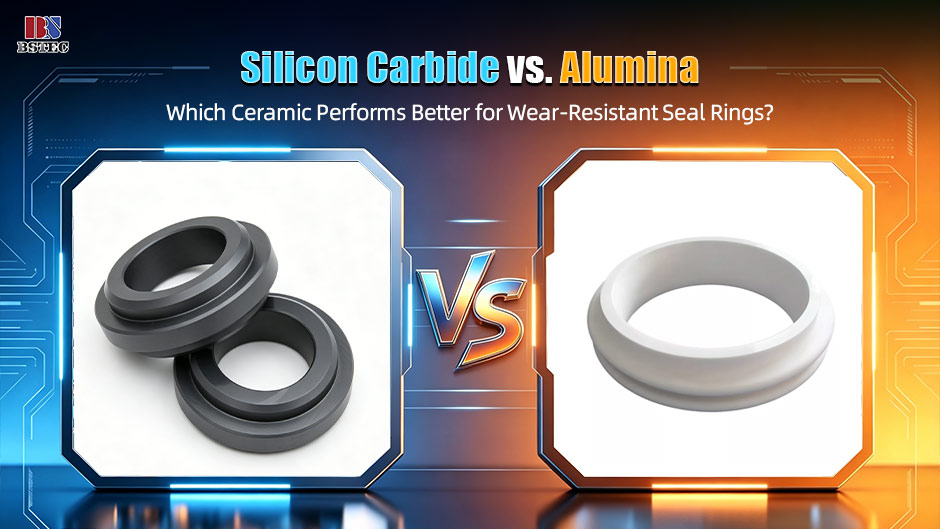
Alumina (aluminum oxide) has long been a workhorse material for wear-resistant components. It is affordable, widely available, and reasonably hard. However, silicon carbide offers significantly better properties for demanding sealing applications. This article compares these two ceramics to help you decide which is right for your seal rings.
Hardness Comparison
Alumina typically achieves Vickers hardness of 1,600–1,850 HV depending on purity and manufacturing process. This is certainly hard—much harder than steel. But silicon carbide reaches 2,500–2,800 HV, making it significantly more resistant to abrasive wear.
In practical terms, this means that in applications with hard particles such as sand, catalyst fines, or metal debris, silicon carbide seal rings will outlast alumina by a factor of two to three times.
Thermal Conductivity
The difference in thermal conductivity is even more dramatic. Alumina conducts heat at approximately 29–32 W/m·K. Silicon carbide conducts at 160 W/m·K—five to six times higher.
For seal rings, this means silicon carbide removes frictional heat from the sealing interface much more effectively. Lower interface temperatures reduce thermal stress, prevent lubricating film breakdown, and extend seal life. Alumina seal rings run hotter, which accelerates wear and increases the risk of thermal cracking.
Fracture Toughness
Alumina has a fracture toughness of approximately 3–4 MPa·m¹⁄². Silicon carbide is similar at approximately 3.5 MPa·m¹⁄². Both materials are brittle and can crack under mechanical shock. Neither has a clear advantage in this category.
For applications with significant shock or vibration, neither alumina nor silicon carbide is ideal. Tungsten carbide or other tougher materials would be better choices.
Corrosion Resistance
Silicon carbide offers superior corrosion resistance, particularly against strong acids and alkalis. Alumina is generally resistant to many chemicals but can be attacked by strong alkalis and hydrofluoric acid. For harsh chemical environments, silicon carbide is the better choice.
Cost Comparison
Alumina is significantly less expensive than silicon carbide. For low-demand applications where extreme wear or corrosion is not a concern, alumina provides acceptable performance at a lower price point. However, for demanding applications, the longer service life of silicon carbide often justifies its higher initial cost.
Which Should You Choose?
Choose alumina for low-cost, low-demand applications where operating conditions are mild. Choose silicon carbide for demanding applications involving abrasives, corrosive chemicals, high temperatures, or high speeds.
Visit our website: www.cnbstec.com to see our full material comparison guide and request a recommendation for your specific application.


