
How Pressureless Sintered Silicon Carbide Achieves Maximum Corrosion Resistance for Seal Rings

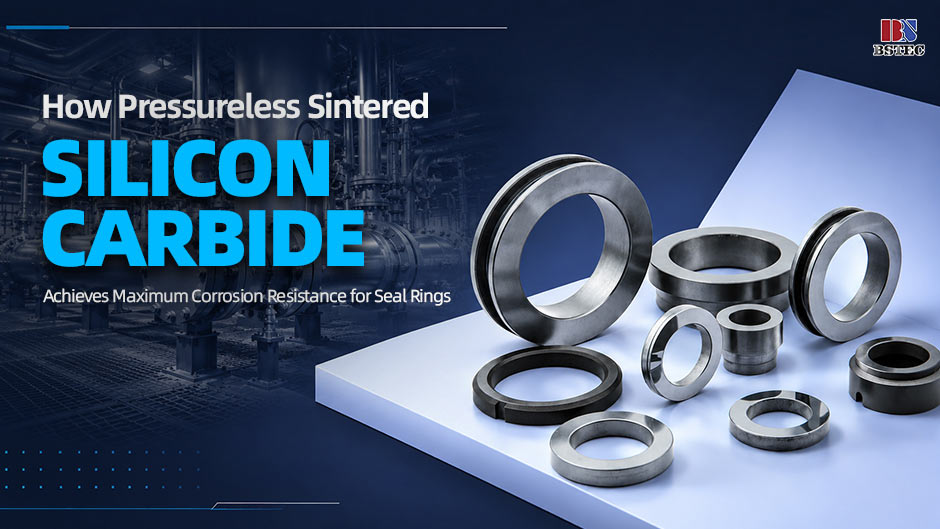
Introduction
Corrosion resistance is one of the most critical properties for seal rings used in chemical processing, semiconductor manufacturing, and other aggressive environments. Among all silicon carbide variants, pressureless sintered silicon carbide (SSiC) offers the highest level of chemical inertness. This article explains how the manufacturing process of SSiC achieves this exceptional corrosion resistance and why it matters for your sealing applications.
The Problem with Free Silicon
Reaction-bonded silicon carbide (RB-SiC) typically contains 5–15% free silicon. This free silicon remains unreacted within the material matrix. While not problematic for many applications, free silicon can be attacked by certain chemicals. Strong alkalis such as sodium hydroxide and potassium hydroxide will gradually dissolve free silicon. Hydrofluoric acid also aggressively attacks silicon components.
For seal rings exposed to these aggressive media, the presence of free silicon creates weak points. Over time, selective leaching of silicon leaves behind a porous, weakened structure. The seal face degrades, leakage increases, and eventually the seal fails completely.
How SSiC Eliminates Free Silicon
Pressureless sintered silicon carbide uses a fundamentally different manufacturing approach. Fine SiC powder is mixed with small amounts of sintering aids—typically boron and carbon—but no additional silicon is introduced. The green body is fired at extremely high temperatures (2,000–2,200°C) in an inert atmosphere. Under these conditions, the SiC particles bond directly to each other through solid-state diffusion.
The result is a material composed of pure silicon carbide with no free silicon phase. The only other elements present are trace amounts of sintering aids, typically less than 1% total. This near-purity provides maximum chemical resistance across the full pH range.
Testing Confirms Superiority
Standard corrosion testing clearly demonstrates the difference. When exposed to 30% sodium hydroxide at 80°C for 24 hours, SSiC shows weight loss of less than 0.01 mg/cm². By comparison, RB-SiC can show weight loss of 5–20 mg/cm² under identical conditions, depending on free silicon content.
Similar results are observed in other aggressive media. Sulfuric acid, hydrochloric acid, and nitric acid all show negligible attack on SSiC. The material also resists organic solvents, molten metals, and many other challenging environments.
Applications That Require SSiC
Certain applications demand the maximum corrosion resistance that only SSiC can provide. Semiconductor manufacturing requires ultra-pure components that will not contaminate wafers. Chemical processing of strong alkalis or hydrofluoric acid demands SSiC. Pharmaceutical manufacturing often specifies SSiC for its clean, non-reactive nature. Food processing equipment that contacts acidic or alkaline cleaning solutions also benefits from SSiC.
Cost Considerations
SSiC typically costs more than RB-SiC due to higher raw material costs and more extensive post-sintering machining. The sintering process causes approximately 20% linear shrinkage, making near-net-shape manufacturing difficult. Complex features must be machined after sintering using diamond tooling.
However, for applications where corrosion resistance is critical, the additional cost is easily justified by longer service life and reduced maintenance.
Visit Our Website for Technical Support
Selecting the right silicon carbide grade for your corrosive application requires expert guidance. At BSTEC, we offer both SSiC and RB-SiC seal rings, and our engineers can help you choose the optimal material based on your specific process chemistry.
Visit our website to access our material selection guide, request a quote, or upload your drawings for a custom solution.


