
Pressure, Flow, and Nozzle Bore: Understanding the Critical Relationship for Optimal Blasting

Pressure, Flow, and Nozzle Bore: Understanding the Critical Relationship for Optimal Blasting
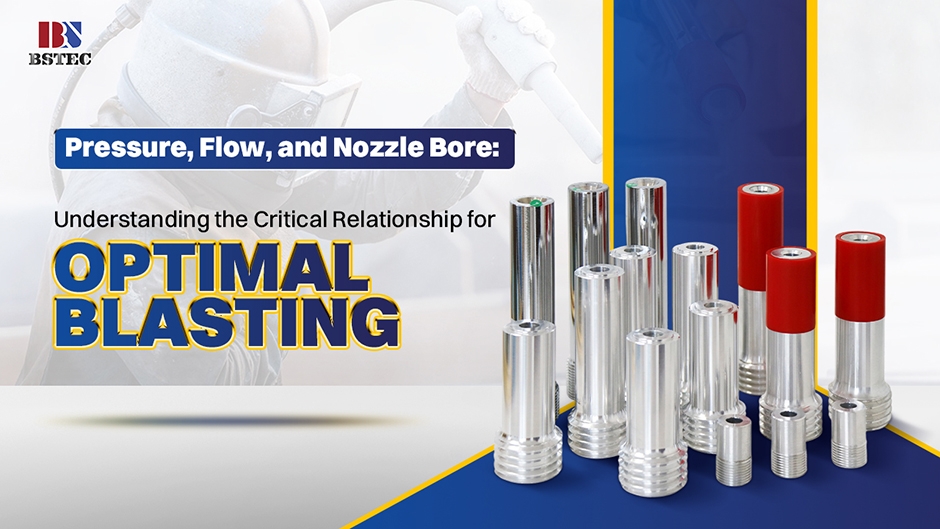
In abrasive blasting, three elements form an unbreakable triad that dictates the success and efficiency of your entire operation: air pressure, air volume (CFM), and nozzle bore size. Misunderstanding the delicate balance between them is a direct path to inflated costs, sluggish progress, and subpar results. To achieve optimal blasting, you must master this critical relationship.
Think of your blasting system as a chain. The compressor generates pressure and volume, the hose is the pathway, and the nozzle is the final, critical gatekeeper. The strength of the entire chain is limited by its weakest link.
The Heart of the System: Your Air Compressor (CFM & PSI)
Air pressure (measured in PSI or BAR) is the force that accelerates the abrasive. Higher pressure typically means faster cleaning. However, pressure is nothing without volume, measured in Cubic Feet per Minute (CFM). CFM represents the sheer quantity of air your compressor can deliver.
This is the most common and critical mistake: selecting a nozzle based on desired pressure alone, without considering the compressor's CFM capacity.
The Governing Rule: The Nozzle Bore Dictates Demand
The nozzle's bore size is not a passive component; it is the element that sets the demand for your entire system. A larger bore orifice requires a significantly greater volume of air (CFM) to maintain a given pressure. There is a direct mathematical relationship:
To double the cleaning speed, you need to quadruple the air volume.
This is why a simple nozzle change can cripple your system's performance. Upgrading to a larger nozzle without verifying your compressor's CFM capability will cause a catastrophic pressure drop at the nozzle.
The Consequences of Imbalance
Oversized Nozzle, Undersized Compressor: This is the most frequent error. Your compressor cannot deliver enough CFM to keep up with the nozzle's demand. The result is a severe pressure drop, a weak, ineffective blast stream, wasted abrasive, and drastically extended project times. You are essentially suffocating your system.
Oversized Compressor, Undersized Nozzle: While less common, this also represents inefficiency. You are paying to run a large compressor that is being throttled back, wasting fuel or electricity. You also risk exceeding the pressure rating of your equipment and creating an overly concentrated, potentially damaging blast pattern.
Achieving the Sweet Spot: System Balance
The key is to match your nozzle bore size precisely to your compressor's CFM output at your target working pressure. Consult a nozzle selection chart: for example, to run a 3/8" nozzle at 100 PSI, you will need a compressor capable of delivering at least 150 CFM at that pressure. If your compressor only produces 100 CFM, you must select a smaller nozzle (e.g., 5/16") or resign yourself to operating at a lower, less efficient pressure.
The Advanced Edge: Venturi Design
Venturi nozzles leverage this relationship masterfully. Their diverging design is engineered to use a given CFM of air more efficiently, creating a wider, more uniform pattern and reducing abrasive rebound. This means you can often achieve a better finish with a smaller, more CFM-efficient Venturi nozzle than with a larger straight-bore nozzle.
Mastering the pressure-flow-bore relationship transforms your blasting from a guessing game into a precise science. For help selecting the perfect nozzle to harmonize with your equipment and maximize your output, consult the experts at www.cnbstec.com. Balance your system, and unlock your true potential.


