
Nozzle Liners Uncovered: Why Tungsten Steel and B4C Choices Impact Your Blast Profile

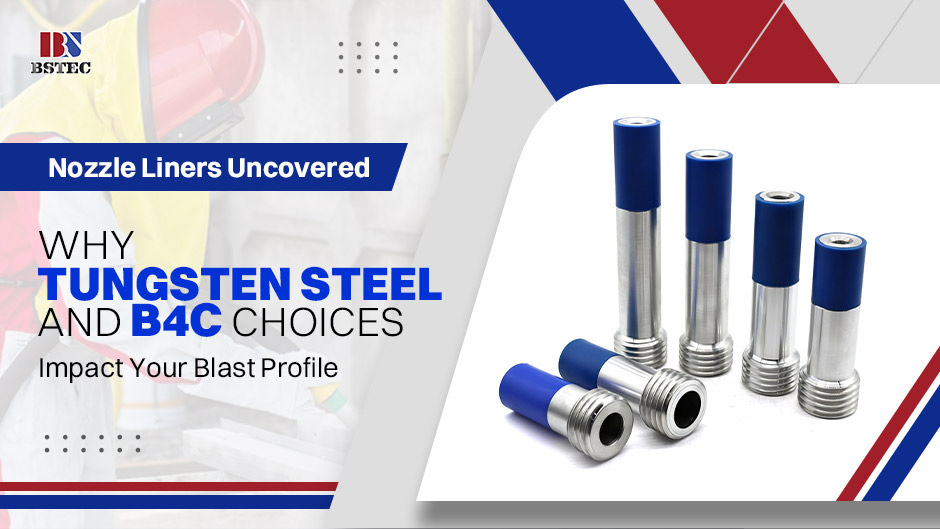
At first glance, an abrasive blasting nozzle might seem like a simple tube. But beneath the surface—quite literally—lies the most critical factor determining your operation's efficiency, cost, and quality: the liner material. This inner sleeve, which bears the full fury of abrasive particles traveling at supersonic speeds, is the true heart of the nozzle.
Choosing the right liner isn't just about longevity; it directly shapes the blast profile—the pattern, velocity, and consistency of the abrasive stream. Two of the most formidable materials in modern surface preparation are Tungsten Steel and Boron Carbide (B4C). Each brings a distinct set of characteristics to the table, and understanding their impact is key to optimizing your blasting process.
In this guide, BSTEC pulls back the curtain on nozzle liners, comparing these two powerhouse materials and showing you how the right choice can transform your blast profile and your bottom line.
1. What Does a Nozzle Liner Actually Do?
Before diving into material science, it's essential to appreciate the liner's role. The liner is the replaceable inner core that comes into direct contact with the abrasive stream. Its primary jobs are:
• Withstand Extreme Erosion: Abrasive particles moving at hundreds of miles per hour would chew through a standard metal nozzle in hours. The liner's wear resistance determines the nozzle's usable life.
• Maintain Internal Geometry: As a liner wears, the internal profile (bore shape, Venturi contours) changes. This degrades the blast pattern, reducing velocity and efficiency. A high-quality liner maintains its shape longer, ensuring consistent performance.
• Define the Blast Profile: The liner's material properties, combined with the nozzle's design, influence how the abrasive stream is accelerated and directed, directly impacting the pattern's width, density, and impact force.
Simply put, the liner is not just a wear part; it's a performance component.
2. Material Face-Off: Tungsten Steel vs. Boron Carbide (B4C)
BSTEC engineers nozzles with premium liner materials to match diverse applications and budgets. Here’s how the two heavyweights compare:
Feature | Tungsten Steel | Boron Carbide (B4C) |
Hardness & Wear Resistance | Extremely hard; significantly outlasts cast iron or standard steel. Excellent for high-volume, aggressive blasting with hard abrasives like aluminum oxide or garnet. | The ultimate in wear resistance. One of the hardest materials known to man, B4C can last 5-10 times longer than Tungsten Carbide in many applications, especially with fine, high-velocity abrasives. |
Impact on Blast Profile | Maintains a consistent, predictable profile over a long service life. Slightly more resistant to chipping from impact than B4C, making it robust for general-purpose use. | Provides exceptional stability. Its extreme hardness means the internal geometry wears so slowly that the blast profile remains virtually unchanged for the vast majority of the nozzle's life, ensuring consistent, repeatable results. |
Cost Consideration | Higher initial cost than standard materials, but offers excellent value due to extended life and reduced downtime for changes. | Highest initial investment. The decision is justified by maximum longevity, minimal downtime, and guaranteed profile consistency—critical for high-production environments and mission-critical coatings work. |
Typical Construction | Often used as a solid liner or in combination with other jackets for enhanced durability. BSTEC incorporates it in specialized designs like our Bending Curved Nozzles with Tungsten Steel + B4C liners. | Typically formed as a dense ceramic tube. BSTEC uses B4C extensively across our range, from Water Induction Nozzles to Venturi and Curved designs. |
3. BSTEC in Action: Liners That Define Performance
BSTEC doesn't just choose materials; we engineer them into precision tools for specific challenges. Consider these examples from our product line:
A. The Ultimate in Longevity: B4C Liners Across the Range
For operations where downtime for nozzle changes is a major cost, or where profile consistency is paramount, B4C is the material of choice.
• Water Induction Nozzles (UWIC Series): These nozzles feature B4C liners to withstand the unique erosive forces of a water-abrasive mix, ensuring long life and consistent dust-suppressed blasting.
• Banana Curved Nozzles (UBCC Series): The demanding geometry of a curved nozzle intensifies wear. The B4C liner here is critical, resisting the constant impact of abrasives changing direction, maintaining the 45° flow for the life of the part.
B. The Power of Combination: Tungsten Steel + B4C Hybrid Liners
Sometimes, the best solution is a hybrid. BSTEC's advanced Bending Curved Nozzles showcase this perfectly.
Bending Curved Nozzle (with PU + Al Jacket, Tungsten Steel + B4C Liner): This design leverages the chip resistance of Tungsten Steel in areas of high impact with the extreme wear resistance of B4C in the high-velocity flow path. The result is a nozzle that can handle the most aggressive abrasives and toughest angles while delivering an extended, predictable service life. Available in multiple thread options (Coarse 2"-4 1/2 UNC, Fine G 1-1/4", G 1") with different jacket combinations (PU+Al, Brass+Steel+Al) to suit any environment.
4. Making the Choice: Which Liner Is Right for Your Blast Profile?
Your decision between Tungsten Steel and B4C should be driven by your specific operational priorities:
- Choose Tungsten Steel when:
● You need a balance of excellent wear life and higher impact resistance.
● You are blasting with very coarse, heavy abrasives where chipping is a concern.
● You want a significant upgrade over standard materials with a manageable investment. (e.g., BSTEC Bending Curved Nozzle variants with Tungsten Steel components).
- Choose Boron Carbide (B4C) when:
● Maximum longevity and minimal downtime are your top priorities.
● Absolute consistency of the blast profile is critical for meeting coating specifications.
● You are working in high-production environments where every minute of nozzle change costs money.
● You need a liner that will outlast the job, guaranteed. (The majority of BSTEC's premium nozzle range).
Conclusion: The Liner Is the Difference
Don't let the liner be an afterthought. It is the single most important factor in your nozzle's performance and your operation's efficiency. Whether you choose the rugged reliability of Tungsten Steel or the unparalleled longevity of Boron Carbide, BSTEC offers expertly engineered nozzles that pair these premium materials with precision designs to deliver the exact blast profile your project demands.
Ready to uncover the difference a premium liner can make? Explore BSTEC's complete range of nozzles featuring Tungsten Steel and B4C liner technology.
Visit www.cnbstec.com today to find the perfect liner material for your blast profile.
BSTEC – The Science of the Surface. The Strength of the Liner.


