
How Blasting Nozzle Geometry (Venturi vs. Straight Bore) Impacts Particle Velocity, Coverage Uniformity, and Surface Finish Quality

How Blasting Nozzle Geometry (Venturi vs. Straight Bore) Impacts Particle Velocity, Coverage Uniformity, and Surface Finish Quality
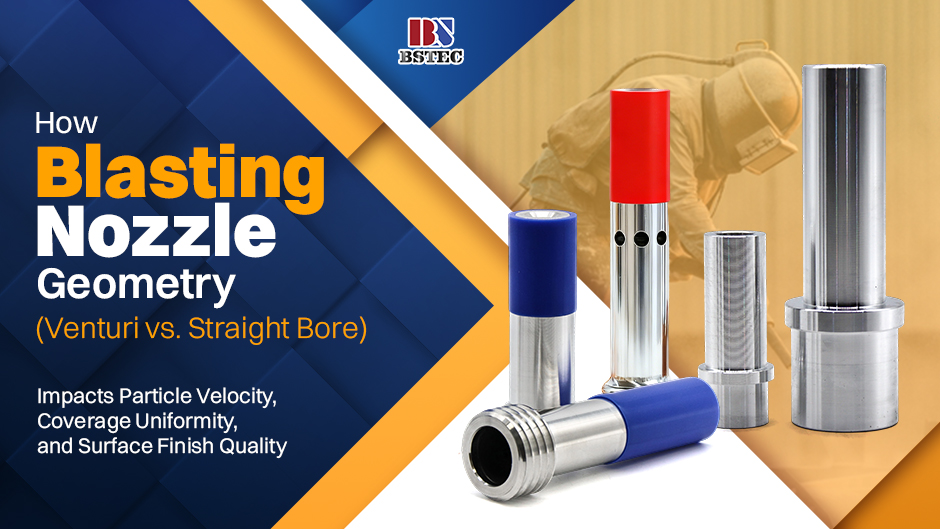
In abrasive blasting, the nozzle is the critical component that transforms air and abrasive into a controlled, effective stream. While pressure and abrasive type are important, the internal geometry of the nozzle—primarily the choice between Venturi and Straight Bore designs—is a fundamental driver of performance, efficiency, and final surface quality.
The table below provides a direct comparison of the two key nozzle geometries:
Feature | Straight Bore Nozzle | Venturi Nozzle |
Internal Design | Constant diameter cylinder | Converging throat, then diverging section |
Airflow Principle | Simple pressure drop | Venturi Effect (pressure converts to velocity) |
Particle Stream | Divergent, flaring pattern | Cohesive, parallel, focused pattern |
Particle Velocity | Lower, inconsistent | Higher, uniform across the stream |
Pattern Uniformity | Poor; central "hot spot" with weak edges | Excellent; even "top-hat" profile |
Abrasive Efficiency | Low; high waste due to spillage and bounce-back | High; optimized particle use and energy transfer |
Typical Surface Finish | Irregular profile, potential for streaking | Consistent, uniform anchor profile |
Best Application | Low-volume spot blasting, delicate work at low pressure | High-production surface preparation, large areas |
Deep Dive: Impact on Operational Outcomes
1. Particle Velocity and Energy Transfer:
The Venturi nozzle's design is engineered for momentum. As air accelerates through the constricted throat, it creates a low-pressure zone that actively pulls abrasive into the center of the stream and accelerates it. This results in a higher average velocity for each abrasive particle. Since kinetic energy is proportional to the square of velocity (KE = 1/2mv²), this increase translates to a dramatic boost in cutting and cleaning power. A straight-bore nozzle lacks this effect, leading to a wider distribution of particle velocities and significant energy loss to turbulence and friction against the bore walls.
2. Coverage Uniformity and Operational Efficiency:
The cohesive stream of a Venturi nozzle creates a blast pattern with even intensity from center to edge. This "top-hat" profile allows an operator to make predictable, overlapping passes, ensuring complete surface coverage without streaks or missed spots. In contrast, the Straight Bore's pattern, with its intense center and weak periphery, forces the operator to make more passes and use a slower, more meticulous technique to avoid creating an uneven surface. This directly impacts job completion time and labor costs.
3. Surface Finish Quality and Coating Adhesion:
The ultimate goal of blasting is often to create an ideal surface for coating adhesion. A consistent, sharp, and uniform anchor profile is paramount. The Venturi nozzle, with its uniform particle impact energy, reliably produces this profile across the entire work surface. The Straight Bore nozzle, however, risks creating a profile with "valleys" that are too deep (from the hot spot) and "peaks" that are insufficiently cleaned, compromising the coating's mechanical bond and leading to potential premature failure.
Conclusion:
The choice between nozzle geometries is a choice between basic function and optimized performance. For small, non-critical tasks, a Straight Bore nozzle may suffice. However, for any industrial application where finish quality, operational speed, and abrasive consumption are concerns, the Venturi nozzle is the unequivocal standard. Its advanced geometry directly controls the key variables of velocity, uniformity, and efficiency, delivering a superior return on investment through higher quality and lower operating costs.


