
Air Nozzles vs. Sandblasting Nozzles for Blasting Guns

Air Nozzles vs. Sandblasting Nozzles for Blasting Guns
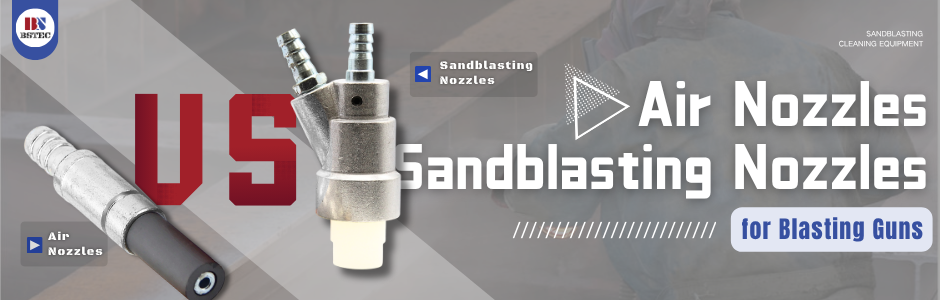
When it comes to sandblasting guns, the air nozzle (also referred to as the air jet or compressed air nozzle) and the sandblasting nozzle play distinct yet complementary roles. Understanding their differences, compatibility, and optimal use is essential for achieving efficient and effective surface treatment.
Core Functions
1. Air Nozzle:
▶The air nozzle is responsible for creating the suction that pulls the abrasive material into the air stream and accelerating the mixture toward the surface being blasted.
▶It is typically designed to work with a range of sandblasting nozzle diameters.
▶In many cases, one air nozzle can handle multiple sandblasting nozzle diameters, as long as the sandblasting nozzles are within the compatible size range.
2. Sandblasting Nozzle:
▶The sandblasting nozzle determines the diameter and pattern of the abrasive stream.
▶Different diameters are used for different applications (e.g., larger diameters for faster material removal, smaller diameters for precision work).
▶You will need to purchase different sandblasting nozzles depending on your specific needs.
Do You Need to Buy Different Air Nozzles?
Typically, no. Most sandblasting guns are designed so that a single air nozzle can accommodate a range of sandblasting nozzle diameters. However, you should always check the manufacturer's specifications to ensure compatibility.
If you are using sandblasting nozzles with extremely different diameters (e.g., very small vs. very large), you might need a different air nozzle to optimize performance.
Key Comparison Table
| Feature | Air Nozzle | Sandblasting Nozzle |
| Primary Function | Generates suction and accelerates the abrasive mixture | Shapes and directs the abrasive stream |
| Compatibility | Works with a range of sandblasting nozzles | Selected based on application needs |
| Material Wear | Low wear; not exposed to direct abrasion | High wear; requires durable materials |
| Common Materials | Plastic, aluminum, brass | Tungsten carbide, boron carbide, ceramic |
| Operating Pressure | 20–150 psi (depending on material) | Varies; optimized for abrasive type and pressure |
| Nozzle Opening | 0.125–0.5 inches | 0.25–0.5 inches (commonly) |
| Application Example | Dust removal, drying, pre-blast cleaning | Rust removal, surface profiling, precision blasting |
Key Considerations
1. Compatibility:
Ensure both nozzles are suitable for your blasting gun model to avoid operational issues.
2 . Performance Matching:
Using an incorrectly sized air nozzle may lead to inefficient abrasive flow and reduced blasting performance.
3. Wear and Maintenance:
Sandblasting nozzles wear out quickly due to abrasive contact. Air nozzles are more durable but should still be inspected regularly.
4 . Application Context:
Air nozzles are often used for non-abrasive auxiliary tasks (e.g., cleaning, drying), while sandblasting nozzles are dedicated to material removal and surface treatment.
Conclusion
While a single air nozzle can often accommodate multiple sandblasting nozzle sizes, it is crucial to verify equipment compatibility and consider specific application requirements. Investing in the correct sandblasting nozzles for your tasks—and ensuring they are suitably matched with your air nozzle—will optimize efficiency, surface quality, and operating cost.


