
Silicon Carbide vs. Silicon Nitride vs. SiAlON Nozzles: Which Material Is Best for Abrasive Blasting?

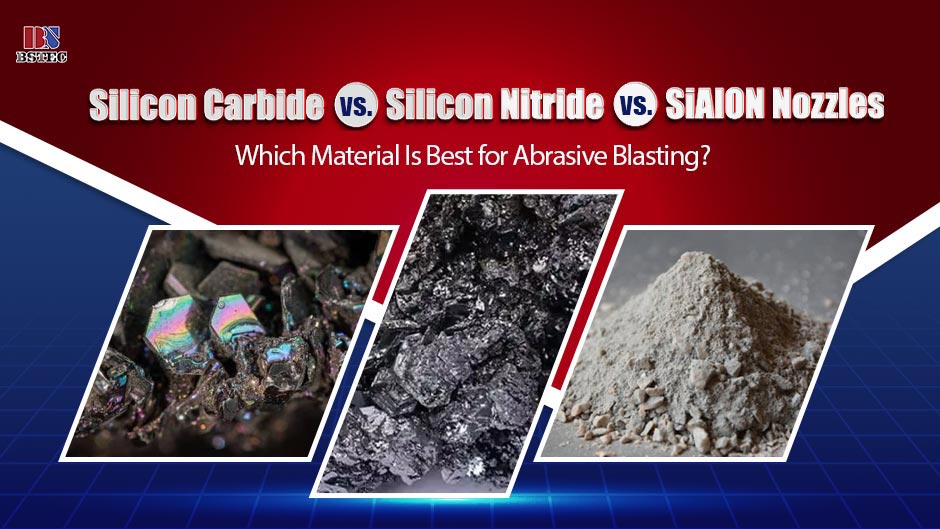
When selecting a blast nozzle, many users focus on nozzle shape, orifice size, and thread type. However, the material of the nozzle liner is equally important because it directly affects service life, blasting efficiency, downtime, and overall operating cost.
Among ceramic blast nozzles, Silicon Carbide (SiC), Silicon Nitride (Si₃N₄), and SiAlON are three of the most commonly discussed materials. Although they all belong to the advanced ceramics family, their mechanical properties and performance characteristics are quite different.
Understanding these differences will help you choose the right nozzle for your blasting application.
Silicon Carbide (SiC): The Industry Standard for Wear Resistance
Silicon Carbide has been one of the most popular materials for abrasive blasting nozzles for decades. Its greatest advantage is its exceptional hardness, typically reaching 9.2–9.5 on the Mohs scale, making it highly resistant to abrasive wear.
This excellent wear resistance allows SiC nozzles to maintain their original bore diameter for a longer period, resulting in stable blasting performance and reduced abrasive consumption.
Another important advantage is its relatively low density. Compared with tungsten carbide nozzles, silicon carbide nozzles are considerably lighter, reducing operator fatigue during extended blasting operations.
In addition, Silicon Carbide offers excellent chemical stability and corrosion resistance, making it suitable for various blasting media including garnet, aluminum oxide, steel grit, and glass beads.
The main limitation of Silicon Carbide is its brittleness. Although it performs exceptionally well under normal blasting conditions, it is more susceptible to cracking if dropped or subjected to severe mechanical impact.
For most industrial blasting applications, however, its outstanding wear resistance and competitive price make Silicon Carbide one of the most cost-effective choices available.
Silicon Nitride (Si₃N₄): Toughness Comes First
Unlike Silicon Carbide, Silicon Nitride is designed primarily for toughness rather than maximum hardness.
Its fracture toughness is significantly higher than that of Silicon Carbide, allowing it to withstand impacts, vibration, and thermal shock much better. This makes Silicon Nitride particularly suitable for environments where nozzles may experience accidental impacts or rough handling.
Another advantage is its excellent resistance to thermal shock. Rapid temperature changes that might crack other ceramics generally have little effect on Silicon Nitride.
However, this improved toughness comes with a compromise.
Because Silicon Nitride is slightly softer than Silicon Carbide, its wear resistance under continuous abrasive blasting is generally lower. In applications where abrasive wear is the dominant failure mechanism, Silicon Carbide often provides a longer service life.
For this reason, Silicon Nitride is commonly used in high-performance engineering components such as bearings, turbocharger rotors, and engine parts, while its use in blast nozzles is relatively limited.
SiAlON: Combining Strength and Wear Resistance
SiAlON is an advanced ceramic developed by modifying Silicon Nitride through the addition of aluminum and oxygen into its crystal structure.
This modification creates a material that combines many of the advantages of both Silicon Carbide and Silicon Nitride.
Compared with conventional Silicon Nitride, SiAlON offers improved wear resistance while maintaining excellent fracture toughness. Compared with Silicon Carbide, it provides much better resistance to impact and mechanical shock.
These balanced properties make SiAlON attractive for demanding industrial environments where equipment experiences both heavy abrasive wear and frequent mechanical stress.
However, these performance advantages come at a cost.
The manufacturing process for SiAlON ceramics is considerably more complex, resulting in significantly higher production costs. Consequently, SiAlON nozzles are generally much more expensive than Silicon Carbide alternatives.
For users operating in highly demanding environments where downtime is extremely costly, the additional investment may be worthwhile. For many standard blasting applications, however, the performance improvement may not justify the increased price.
Is Silicon Carbide an Equivalent Replacement for SiAlON?
This is one of the questions we hear most frequently from customers.
The short answer is no.
Silicon Carbide and SiAlON are not equivalent materials because they are designed with different priorities.
Silicon Carbide prioritizes maximum hardness and wear resistance, while SiAlON focuses on achieving an optimal balance between wear resistance and fracture toughness.
Nevertheless, Silicon Carbide can often serve as an excellent practical alternative to SiAlON in many abrasive blasting applications.
If your blasting process mainly involves continuous abrasive wear with minimal mechanical impact, a high-quality Silicon Carbide nozzle can deliver excellent performance at a substantially lower cost.
On the other hand, if your nozzles are frequently subjected to impacts, vibration, or harsh mechanical conditions, SiAlON may provide a longer overall service life despite its higher initial purchase price.
Which Material Should You Choose?
There is no universal "best" nozzle material.
The ideal choice depends on your blasting conditions, abrasive media, operating pressure, working environment, and budget.
● Choose Silicon Carbide if your priority is maximum wear resistance, lightweight handling, and the best cost-performance ratio.
● Choose Silicon Nitride if impact resistance and thermal shock resistance are more important than ultimate wear life.
● Choose SiAlON if your application demands both excellent wear resistance and superior toughness, and minimizing downtime outweighs the higher purchase cost.
Final Thoughts
Selecting the correct nozzle material is not simply about choosing the hardest ceramic. It is about balancing wear life, toughness, operating conditions, and total cost of ownership.
For the vast majority of abrasive blasting operations, Silicon Carbide remains the industry benchmark for performance and value, offering an excellent combination of durability, lightweight handling, and affordability.
At BSTEC, we supply high-quality Silicon Carbide, Boron Carbide, and Tungsten Carbide blast nozzles manufactured under strict quality control to help customers achieve reliable blasting performance while optimizing operating costs.
If you're unsure which nozzle material is best suited for your application, our technical team is always happy to help you select the most appropriate solution.


