
Silicon Carbide Seal Rings Manufacturing Process: From Powder to Product

Introduction
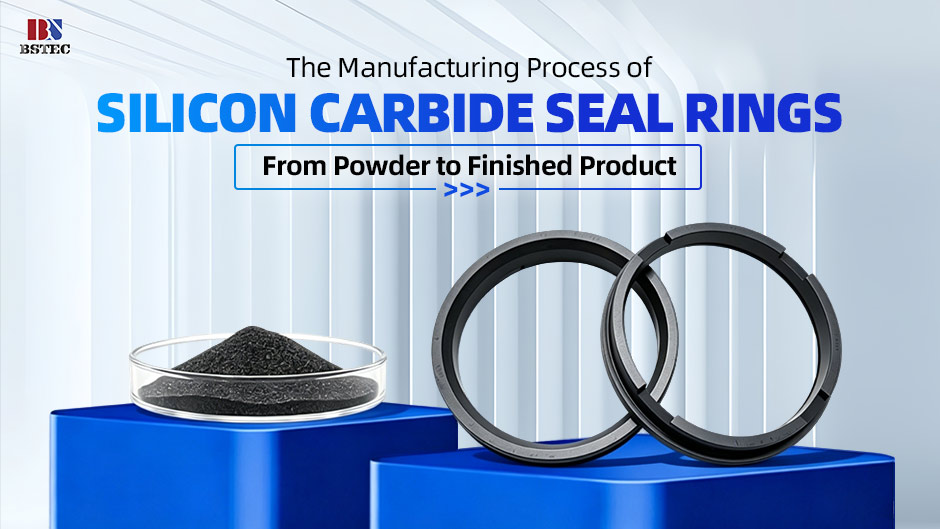
Understanding how silicon carbide seal rings are made helps buyers appreciate the value of high-quality components. The journey from raw powder to finished seal ring involves multiple sophisticated steps, each requiring precise control. This article walks through the complete manufacturing process for reaction-bonded and pressureless-sintered silicon carbide seal rings.
Raw Material Preparation
The process begins with high-purity silicon carbide powder. For pressureless sintering, the powder must be extremely fine—typically submicron particle size. Sintering aids (boron and carbon) are added in precise amounts. The powder mixture is then milled to ensure uniform distribution of all ingredients.
For reaction-bonded SiC, the powder mixture includes carbon sources in addition to SiC. The carbon will later react with infiltrated silicon to form additional silicon carbide.
Forming the Green Body
The prepared powder is formed into a shape close to the final seal ring. Common forming methods include uniaxial pressing, cold isostatic pressing (CIP), or injection molding for complex shapes. The formed but unsintered part is called a "green body."
At this stage, the green body is fragile but holds its shape. It can be machined to add features before sintering—a process called green machining.
Sintering
Sintering is the critical step that transforms loose powder into a dense, strong ceramic. For pressureless sintering, the green body is fired in a high-temperature furnace at 2,000–2,200°C in an inert atmosphere. The particles bond directly without applied pressure, but the part shrinks by approximately 20%.
For reaction bonding, the porous carbon-containing preform is infiltrated with molten silicon at approximately 1,500°C. The silicon reacts with carbon to form additional SiC, filling pores. This process causes minimal shrinkage, enabling near-net-shape manufacturing.
Diamond Machining
Sintered silicon carbide is extremely hard— second only to diamond. Conventional machining tools cannot cut it. Instead, diamond grinding and lapping are used. CNC diamond grinders achieve tight tolerances. Diamond lapping plates create the ultra-flat, smooth finish required for seal faces.
This machining step is time-consuming and expensive, which is a major reason why precision SiC components cost more than metal alternatives.
Quality Inspection
Finished seal rings undergo rigorous inspection. Dimensional measurements ensure tolerances are met. Surface finish is checked using profilometers. Hardness and density may be tested on representative samples. Some critical applications require 100% inspection of all dimensions and surface defects.
Quality You Can Trust
At BSTEC, we control every step of the manufacturing process to ensure consistent, high-quality silicon carbide seal rings. Our quality management system is certified to international standards.


