
Remote Control Systems and Collaborative Application Benefits of Blasting Equipment

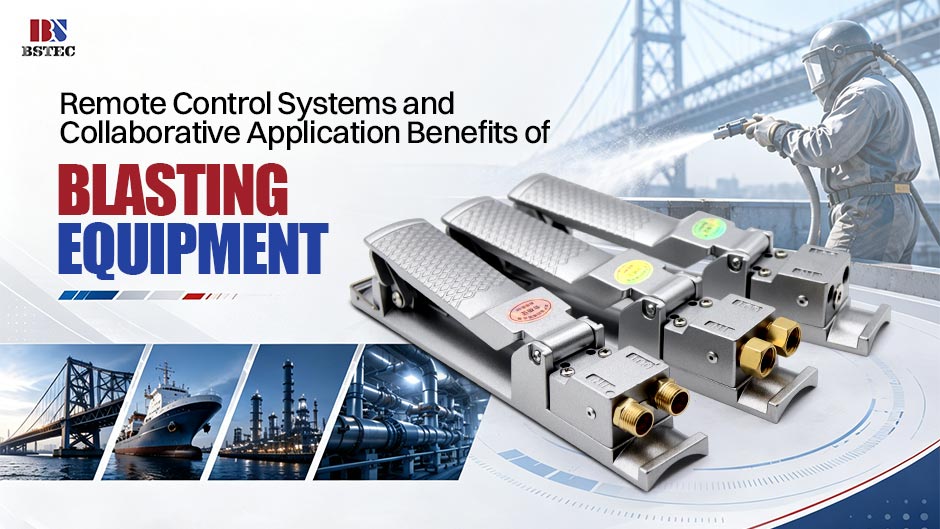
Introduction
Traditional abrasive blasting operations rely on manual on-site adjustment and real-time machine operation, which has prominent defects such as high operational risk, low construction efficiency and unstable processing quality. With the upgrading of industrial safety production standards and intelligent manufacturing requirements, remote control systems have become a standard supporting configuration for high-end blasting equipment. Combined with pneumatic automatic metering valves, the remote control system realizes integrated intelligent control of abrasive conveying and blasting operation, effectively solving the pain points of high risk, high consumption and low efficiency in traditional blasting work, and greatly improving the overall level of industrial surface treatment operations.
Functions and Design Advantages of Remote Control Systems
The remote control system is the intelligent operation hub of modern blasting equipment, realizing remote start-stop, emergency shutdown and real-time state monitoring of blasting operations. It changes the traditional working mode of manual operation beside the machine, allowing operators to hold the control terminal near the blasting nozzle for flexible operation. Most industrial-grade remote controls adopt a mature fail-safe design: when the operator releases the controller or encounters accidental operation errors, the system will automatically cut off the abrasive supply and stop blasting immediately, avoiding safety accidents caused by equipment runaway and greatly improving the safety of high-risk blasting operations.
Classification and Scenario Matching of Remote Control Systems
According to different driving modes and environmental adaptability, blasting remote control systems are divided into pneumatic and electric types, with obvious differences in applicable working conditions:
Control System Type | Maximum Control Distance | Environmental Adaptability | Functional Characteristics | Application Scenarios |
Pneumatic Remote Control System | 100 feet | Excellent anti-interference, no electric leakage risk, suitable for humid, dusty and open-air environments | Simple operation, stable signal, fail-safe basic protection function | Outdoor bridge maintenance, ship surface blasting, field engineering construction |
Electric Remote Control System | Long-distance transmission | Sensitive to severe dust and humid corrosion environments, suitable for standardized indoor workshops | High-precision signal feedback, real-time data monitoring, compatible with intelligent management | Industrial production lines, indoor large equipment derusting, long-distance pipeline blasting |
Key Takeaways: Remote Control Matching Principles
· Pneumatic remote systems are the safest choice for outdoor, humid, and high-dust complex construction environments.
· Electric remote systems are more suitable for standardized indoor production requiring data monitoring and long-distance control.
Comprehensive Advantages of Integrated Collaborative System
The collaborative operation of abrasive metering valves and remote control systems achieves comprehensive upgrades in quality, cost, safety and efficiency compared with traditional manual blasting, as shown in the comparison table below:
Evaluation Dimension | Traditional Manual Blasting | Integrated Valve & Remote Control System |
Blasting Quality | Unstable abrasive flow, uneven surface roughness, prone to cleaning defects | Stable abrasive-air mixing ratio, consistent blasting effect, high coating bonding strength |
Material & Maintenance Cost | Serious abrasive waste, frequent equipment vibration deviation, high maintenance consumption | Precise metering reduces waste, wear-resistant parts have long service life, low downtime cost |
Operation Safety | Operators work close to high-pressure equipment, high risk of splashing injury | Remote isolation operation, fail-safe emergency stop, double safety protection |
Operation Efficiency | Manual frequent adjustment, slow response, low overall efficiency | One-key remote control, instant start-stop and adjustment, greatly improved construction efficiency |
The integrated system realizes isolated operation of personnel and high-pressure equipment, eliminating the safety hazard of abrasive splashing and equipment runaway. At the same time, precise remote start-stop and flow control effectively reduce unnecessary abrasive consumption and manual adjustment time, achieving dual optimization of economic benefit and construction efficiency.
Intelligent Development Trend
With the development of industrial intelligence, the integrated system of metering valves and remote controls is evolving toward digitalization, automation and high durability. New intelligent devices are equipped with real-time monitoring sensors, which can collect operating data such as abrasive consumption and working pressure to realize refined digital management of blasting processes.
Future Development Trends
· Digitalization: Real-time data monitoring and intelligent statistics of abrasive consumption and operating parameters.
· Automation: Unmanned adaptive blasting with automatic flow adjustment according to surface conditions.
· High durability: New wear-resistant materials to reduce equipment maintenance frequency and comprehensive operating costs.
Conclusion
Remote control systems are the core intelligent guarantee for modern high-efficiency and safe blasting operations. Combined with high-precision abrasive metering valves, they completely subvert the limitations of traditional manual blasting. The integrated system realizes standardized quality control, low-cost operation and high-safety construction, which is of great significance for promoting the intelligent upgrading of the global surface treatment industry and meeting the increasingly stringent industrial construction standards.


