
Beyond the Basics: Understanding Nozzle Bore Shapes and Their Impact on Blasting Performance

Beyond the Basics: Understanding Nozzle Bore Shapes and Their Impact on Blasting Performance
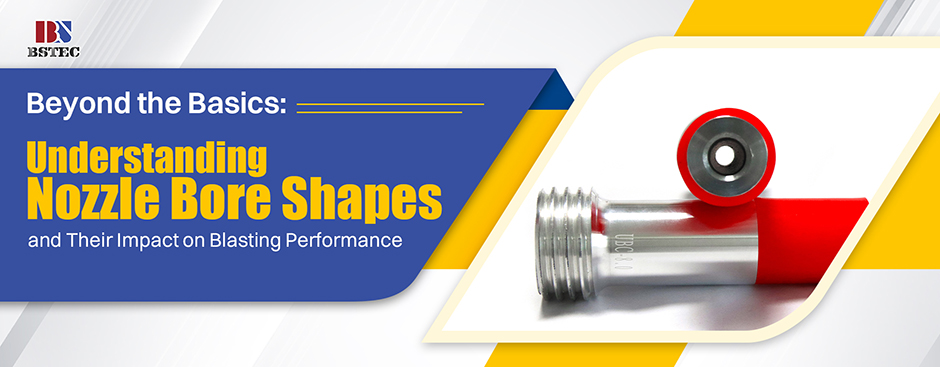
In abrasive blasting, the focus often falls on the nozzle's material. However, the internal bore shape is an equally critical engineering decision that directly controls the blast pattern, efficiency, and overall cost of the operation. Choosing between a straight bore and a venturi nozzle is not a matter of preference but of physics and project requirements. Understanding this distinction is the key to unlocking faster cleaning times, superior finish quality, and significant savings on abrasive media.
The straightforward straight bore nozzle features a cylindrical passage from inlet to outlet. This design produces a tight, concentrated stream of abrasive, delivering aggressive, high-impact energy on a small area. This makes it ideal for specific tasks like spot blasting, removing heavy welds, or working in confined spaces where precision is paramount. However, this focused power comes with significant drawbacks. The concentrated stream leads to faster media breakdown, creating more dust. Furthermore, straight bore nozzles are notoriously inefficient in their use of compressed air, leading to higher energy consumption for the amount of surface area cleaned.
In contrast, Venturi nozzles utilize a more advanced, hourglass-like design based on Bernoulli's Principle. The bore constricts to accelerate the abrasive-air mixture and then expands in a controlled manner. This expansion causes the stream to widen into a uniform, fan-shaped pattern. The result is a much more consistent finish and a dramatically larger cleaning footprint. The Standard Venturi offers a excellent balance, providing a wider pattern and better efficiency than a straight bore.
For peak performance, the Long Venturi (or Double-Venturi) nozzle is the industry champion. Its extended, two-stage design further refines the air-abrasive flow. The primary benefits are a exceptionally uniform pattern and a remarkable reduction in abrasive consumption and airborne dust—by as much as 20-40% compared to a straight bore. By keeping the media in a consolidated stream for longer, it minimizes wasteful bounce-back and particle collision, ensuring more abrasive hits the workpiece with optimal energy.
Selecting the right bore shape is a direct function of the task. For cleaning large, flat surfaces like ship hulls or storage tanks, the Long Venturi's speed and efficiency are unparalleled. Its dust-reducing properties also make it the best choice for environmentally sensitive or enclosed spaces. Conversely, for detailed work like cleaning intricate ironwork or targeting specific defects, the pinpoint accuracy of a straight bore remains indispensable.
Ultimately, moving beyond a one-size-fits-all approach to nozzle selection is a mark of a professional operation. By matching the nozzle bore geometry to the project—using a Long Venturi for broad-area productivity and a straight bore for precision tasks—operators can achieve not only a better finish but also realize substantial savings in time, energy, and abrasive media, transforming the nozzle from a simple tool into a strategic asset.


